
Journal of International Reproductive Health/Family Planning ›› 2026, Vol. 45 ›› Issue (4): 306-310.doi: 10.12280/gjszjk.20260238
• Review • Previous Articles Next Articles
LIU Jin-yu, MA Rui-hong, ZHAO Zhi-mei( )
)
Received:2026-05-07
Published:2026-07-15
Online:2026-07-27
Contact:
ZHAO Zhi-mei
E-mail:zhaozhim2003@aliyun.com
LIU Jin-yu, MA Rui-hong, ZHAO Zhi-mei. Research Progress on the Animal Models and Mechanisms of Psychological Stress-Induced Reproductive Dysfunction[J]. Journal of International Reproductive Health/Family Planning, 2026, 45(4): 306-310.
Add to citation manager EndNote|Ris|BibTeX
| 名称 | 造模原理 | 核心行为学改变 |
|---|---|---|
| 慢性束缚应激 | 躯体+心理限制 | 焦虑样行为、探索性下降 |
| 慢性不可预知性温和应激 | 不可预测性刺激 | 快感缺失、绝望行为 |
| 社交挫败应激 | 社会对抗失败 | 社交回避、焦虑、抑郁 |
| 社交隔离应激 | 长期社会剥夺 | 认知缺陷、焦虑、攻击性 |
| 早期生命应激 | 早期亲子依恋中断 | 成年后应激敏感性升高、HPA轴编程改变 |
| 名称 | 造模原理 | 核心行为学改变 |
|---|---|---|
| 慢性束缚应激 | 躯体+心理限制 | 焦虑样行为、探索性下降 |
| 慢性不可预知性温和应激 | 不可预测性刺激 | 快感缺失、绝望行为 |
| 社交挫败应激 | 社会对抗失败 | 社交回避、焦虑、抑郁 |
| 社交隔离应激 | 长期社会剥夺 | 认知缺陷、焦虑、攻击性 |
| 早期生命应激 | 早期亲子依恋中断 | 成年后应激敏感性升高、HPA轴编程改变 |
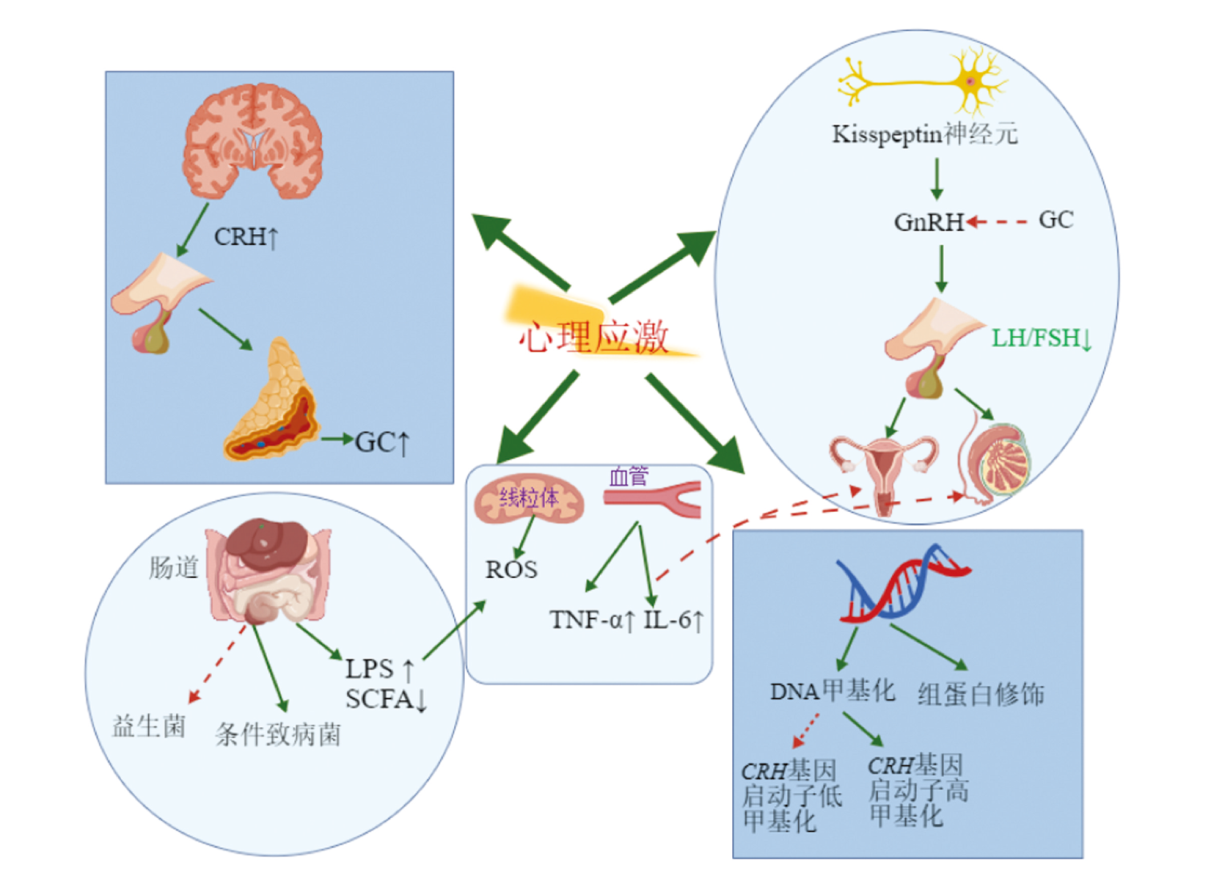
| [1] |
Sapolsky RM. Stress and the brain: individual variability and the inverted-U[J]. Nat Neurosci, 2015, 18(10):1344-1346. doi: 10.1038/nn.4109.
pmid: 26404708 |
| [2] |
McEwen BS. Physiology and neurobiology of stress and adaptation: central role of the brain[J]. Physiol Rev, 2007, 87(3):873-904. doi: 10.1152/physrev.00041.2006.
pmid: 17615391 |
| [3] | Kaltsas A. Oxidative Stress and Male Infertility: The Protective Role of Antioxidants[J]. Medicina(Kaunas), 2023, 59(10):1769. doi: 10.3390/medicina59101769. |
| [4] | Han Y, Lin X. The relationship between psychological stress and ovulatory disorders and its molecular mechanisms: a narrative review[J]. J Psychosom Obstet Gynaecol, 2024, 45(1):2418110. doi: 10.1080/0167482X.2024.2418110. |
| [5] | Selye H. A syndrome produced by diverse nocuous agents. 1936[J]. J Neuropsychiatry Clin Neurosci, 1998, 10(2):230-231. doi: 10.1176/jnp.10.2.230a. |
| [6] |
Paré WP. Passive-avoidance behavior in Wistar-Kyoto (WKY), Wistar, and Fischer-344 rats[J]. Physiol Behav, 1993, 54(5):845-852. doi: 10.1016/0031-9384(93)90291-m.
pmid: 8248372 |
| [7] | Chiba S, Numakawa T, Ninomiya M, et al. Chronic restraint stress causes anxiety- and depression-like behaviors, downregulates glucocorticoid receptor expression, and attenuates glutamate release induced by brain-derived neurotrophic factor in the prefrontal cortex[J]. Prog Neuropsychopharmacol Biol Psychiatry, 2012, 39(1):112-119. doi: 10.1016/j.pnpbp.2012.05.018. |
| [8] |
Singh S, Tripathy S, Rawat A, et al. Pre-clinical Investigations of Therapeutic Markers Associated with Acute and Chronic Restraint Stress: A Nuclear Magnetic Resonance Based Contrast Metabolic Approach[J]. Nanotheranostics, 2023, 7(1):91-101. doi: 10.7150/ntno.76294.
pmid: 36593795 |
| [9] |
Katz RJ, Roth KA, Carroll BJ. Acute and chronic stress effects on open field activity in the rat: implications for a model of depression[J]. Neurosci Biobehav Rev, 1981, 5(2):247-251. doi: 10.1016/0149-7634(81)90005-1.
pmid: 7196554 |
| [10] | Willner P. Validity, reliability and utility of the chronic mild stress model of depression: a 10-year review and evaluation[J]. Psychopharmacology(Berl), 1997, 134(4):319-329. doi: 10.1007/ s002130050456. |
| [11] |
Golden SA, Covington HE, Berton O, et al. A standardized protocol for repeated social defeat stress in mice[J]. Nat Protoc, 2011, 6(8):1183-1191. doi: 10.1038/nprot.2011.361.
pmid: 21799487 |
| [12] |
Berton O, McClung CA, Dileone RJ, et al. Essential role of BDNF in the mesolimbic dopamine pathway in social defeat stress[J]. Science, 2006, 311(5762):864-868. doi: 10.1126/science. 1120972.
pmid: 16469931 |
| [13] | Kudryavtseva NN. A sensory contact model for the study of aggressive and submissive behavior in male mice[J]. Aggressive Behav, 1991, 17(5):285-291. doi: 10.1002/1098-2337(1991)17:5<285::AID-AB2480170505>3.0.CO;2-P. |
| [14] | Harlow HF, Suomi SJ. Social recovery by isolation-reared monkeys[J]. Proc Natl Acad Sci U S A, 1971, 68(7):1534-1538. doi: 10.1073/pnas.68.7.1534. |
| [15] |
Fone KC, Porkess MV. Behavioural and neurochemical effects of post-weaning social isolation in rodents-relevance to developmental neuropsychiatric disorders[J]. Neurosci Biobehav Rev, 2008, 32(6):1087-1102. doi: 10.1016/j.neubiorev.2008. 03.003.
pmid: 18423591 |
| [16] | Plotsky PM, Meaney MJ. Early, postnatal experience alters hypothalamic corticotropin-releasing factor (CRF) mRNA, median eminence CRF content and stress-induced release in adult rats[J]. Brain Res Mol Brain Res, 1993, 18(3):195-200. doi: 10.1016/0169-328x(93)90189-v. |
| [17] | Handa RJ, Weiser MJ. Gonadal steroid hormones and the hypothalamo-pituitary-adrenal axis[J]. Front Neuroendocrinol, 2014, 35(2):197-220. doi: 10.1016/j.yfrne.2013.11.001. |
| [18] |
Herman JP, McKlveen JM, Ghosal S, et al. Regulation of the Hypothalamic-Pituitary-Adrenocortical Stress Response[J]. Compr Physiol, 2016, 6(2):603-621. doi: 10.1002/cphy.c150015.
pmid: 27065163 |
| [19] |
Chandran UR, Attardi B, Friedman R, et al. Glucocorticoid receptor-mediated repression of gonadotropin-releasing hormone promoter activity in GT1 hypothalamic cell lines[J]. Endocrinology, 1994, 134(3):1467-1474. doi: 10.1210/endo.134.3.8119188.
pmid: 8119188 |
| [20] | Pereira SA, Fontes AN, Arvizu-sanchez L, et al. OR23-02 GABAergic and Kisspeptin Neurons Mediate Effects of Stress-induced Glucocorticoids on Reproduction in an Opposite Manner in Female Mice[J]. J Endocr Soc, 2024, 8(Suppl 1):bvae163.2426. doi: 10.1210/jendso/bvae163.2426. |
| [21] | Medina H, Flores A, Juárez-Rojas L, et al. Chronic stress disturbs neuroendocrine control of reproduction and fertility in male rats[J]. Reprod Biol, 2025, 25(3):101027. doi: 10.1016/j.repbio. 2025.101027. |
| [22] | Silva V, Soares S, Miguelote R. Psychological stress and functional ovarian suppression in women with PCOM: an observational study of FHA-like neuroendocrine phenotypes[J]. Arch Womens Ment Health, 2026, 29(1):10. doi: 10.1007/s00737-025-01657-z. |
| [23] | Mohamed ZI, Sivalingam M, Radhakrishnan AK, et al. Chronic unpredictable stress (CUS) reduced phoenixin expression, induced abnormal sperm and testis morphology in male rats[J]. Neuropeptides, 2024, 107:102447. doi: 10.1016/j.npep.2024. 102447. |
| [24] | 程蕊, 刘妍, 杨慧, 等. 不同程度心理应激对小鼠卵巢内氧化应激水平的影响[J]. 国际生殖健康/计划生育杂志, 2020, 39(2):93-96. doi: 10.3969/j.issn.1674-1889.2020.02.001. |
| [25] | Sharma P, Kaushal N, Saleth LR, et al. Oxidative stress-induced apoptosis and autophagy: Balancing the contrary forces in spermatogenesis[J]. Biochim Biophys Acta Mol Basis Dis, 2023, 1869(6): 166742. doi: 10.1016/j.bbadis.2023.166742. |
| [26] | Mo L, Wu H, Zhang M, et al. The mechanism of oxidative stress in asthenozoospermia and antioxidant strategies: a review[J]. Front Endocrinol(Lausanne), 2025, 16:1670762. doi: 10.3389/fendo. 2025.1670762. |
| [27] | 阿孜古丽·阿力木江, 买买提·依斯热依力, 王婧, 等. 心理应激对雌性小鼠胃黏膜炎症和卵巢功能早衰的影响[J]. 中华胃食管反流病电子杂志, 2023, 10(2):69-76. doi: 10.3877/cma.j.issn.2095-8765.2023.02.003. |
| [28] | van der Burg B, Liden J, Okret S, et al. Nuclear factor-κB repression in antiinflammation and immunosuppression by glucocorticoids[J]. Trends Endocrinol Metab, 1997, 8(4):152-157. doi: 10.1016/s1043-2760(97)00006-4. |
| [29] | Zhang J, Kong DL, Xiao B, et al. Restraint stress of male mice triggers apoptosis in spermatozoa and spermatogenic cells via activating the TNF-α system[J]. Zygote, 2020:28(2):145-154. doi: 10.1017/S0967199419000844. |
| [30] | Zhao XL, Rong BL, Dou Z, et al. Kai Yu Zhong Yu recipe mitigates stress-induced accelerated follicle loss in mice by regulating the interplay between apoptosis and autophagy via the SIRT1/FOXO1/3 pathway[J]. Phytomedicine Plus, 2024, 4(4):100623. doi: 10.1016/j.phyplu.2024.100623. |
| [31] | Zheng JC, Jin ZR, Liu BH, et al. Chronic stress drives oligoasthenozoospermia via gut microbiota-vitamin-Sting1/Slc9c2 axis[J]. Nat Commun, 2026, 17(1):4108. doi: 10.1038/s41467-026-72450-4. |
| [32] | Fu L, Wang M, Li D, et al. Microbial metabolites short chain fatty acids, tight junction, gap junction, and reproduction: a review[J]. Front Cell Dev Biol, 2025, 13:1624415. doi: 10.3389/fcell. 2025.1624415. |
| [33] | Khazaei M, Bahar A, Porbaran M, et al. Diet and gut microbiota during depression and stress[J]. Discover Food, 2026, 6:111. doi: 10.1007/s44187-026-00846-8. |
| [34] |
Akhatova A, Jones C, Coward K, et al. How do lifestyle and environmental factors influence the sperm epigenome? Effects on sperm fertilising ability, embryo development, and offspring health[J]. Clin Epigenetics, 2025, 17(1):7. doi: 10.1186/s13148-025-01815-1.
pmid: 39819375 |
| [35] | Khor YM, Soga T, Parhar IS. Early-life stress changes expression of GnRH and kisspeptin genes and DNA methylation of GnRH3 promoter in the adult zebrafish brain[J]. Gen Comp Endocrinol, 2016, 227:84-93. doi: 10.1016/j.ygcen.2015.12.004. |
| [36] | Ohno H, Yamamuro Y, Aizawa S. Chronic social defeat stress alters DNA methylation profiles of male germ cells in mice[J]. Biochem Biophys Res Commun, 2025, 758:151650. doi: 10.1016/j.bbrc.2025.151650. |
| [37] |
Xu J, Wang R, Liu Y, et al. Short- and long-term alterations of FKBP5-GR and specific microRNAs in the prefrontal cortex and hippocampus of male rats induced by adolescent stress contribute to depression susceptibility[J]. Psychoneuroendocrinology, 2019, 101:204-215. doi: 10.1016/j.psyneuen.2018.11.008.
pmid: 30469088 |
| [1] | HE Fang-yu, ZHANG Run-yao, GAO Ming-xia. Impact of Female Genital Tuberculosis on Fertility and Its Prevention and Management in Women Undergoing In Vitro Fertilization and Embryo Transfer [J]. Journal of International Reproductive Health/Family Planning, 2026, 45(5): 407-411. |
| [2] | LI Xiao-lian, ZHANG Meng-yu, TAO Hui-min, FAN Yu-han, LI Mei, YIN Yao-xue, HOU Zhen. Treatment Pathways Selection for Deeply Infiltrating Endometriosis with Infertility: Surgery or IVF? [J]. Journal of International Reproductive Health/Family Planning, 2026, 45(5): 412-417. |
| [3] | CHEN Hai-xia, YANG Lin, MU Xiao-huan, SONG Xue-ru, TIAN Wen-yan, BAI Xiao-hong. Compound Heterozygous Mutations in SUN5 Cause Acephalic Spermatozoa: A Case Report [J]. Journal of International Reproductive Health/Family Planning, 2026, 45(4): 285-289. |
| [4] | CHEN Tian-ze, WANG Dan-dan, HONG Ju-sheng, YANG Guang-ping. Research Progress on the Growth Hormone/Insulin-Like Growth Factor-1 Axis in Regulating Male Reproductive Function [J]. Journal of International Reproductive Health/Family Planning, 2026, 45(4): 301-305. |
| [5] | WEI Qian, HE Yu-jie. Research Progress on Comorbidity Mechanisms of Mental Disorders and Reproductive System Diseases [J]. Journal of International Reproductive Health/Family Planning, 2026, 45(3): 236-241. |
| [6] | SUN Ning, YANG Jin-ji, HU Chun-xiu. Mechanism and Application of Gratitude Intervention in Psychological Adjustment of Infertile Individuals [J]. Journal of International Reproductive Health/Family Planning, 2026, 45(3): 242-246. |
| [7] | KONG Jing, YU Lan, ZHANG Cui-lian. The Impact of Vitamin D on Assisted Reproductive Technology Outcomes in Women with Polycystic Ovary Syndrome [J]. Journal of International Reproductive Health/Family Planning, 2026, 45(2): 154-159. |
| [8] | ZHOU Jun, PEI Jing-liang, PANG Hai-yan, ZHANG Mao-xiang, TIAN Yan-ya, WANG Gui-ling. A Case of Male Infertility Resulting from A Complex Chromosomal Rearrangement Involving Seven Chromosomes [J]. Journal of International Reproductive Health/Family Planning, 2026, 45(1): 23-27. |
| [9] | CHEN Jia-lang, ZHANG Yun-shan, WANG Guang-teng, PANG Ze-hui. The Impact of Sperm DNA Fragmentation on Intrauterine Insemination Outcomes and Intervention Strategies [J]. Journal of International Reproductive Health/Family Planning, 2026, 45(1): 40-44. |
| [10] | GONG Zheng, GONG Chun-ming, FU Yu, XIA Tian. The Theoretical Connotation and Modern Application Implications of "Infertility Caused by Gong-Han" [J]. Journal of International Reproductive Health/Family Planning, 2025, 44(6): 481-485. |
| [11] | XIAO Jin-xin, XIONG Meng-neng, XIE Qing-zhen. Heterogeneous Nuclear Ribonucleoprotein in Regulating Oocyte Development [J]. Journal of International Reproductive Health/Family Planning, 2025, 44(6): 486-489. |
| [12] | SHI Xue-ying, YANG Jin-ji, FU Hao, HU Chun-xiu. The Mechanism of High Fat Diet-Induced Sperm Morphological Abnormalities [J]. Journal of International Reproductive Health/Family Planning, 2025, 44(6): 490-495. |
| [13] | YANG Jing, JI Dong-mei. Progress in Enucleated Oocyte Donation and Its Clinical Application [J]. Journal of International Reproductive Health/Family Planning, 2025, 44(6): 496-500. |
| [14] | CUI Yu-fei, JIA Dong-ling, WANG Li-yan, LI Fu-lan, LIU Hui-hui, ZHANG Li-hong, HU Rong, HU Jun-ping. Mindfulness-Based Interventions in Patients Undergoing In Vitro Fertilization-Embryo Transfer: A Scoping Review [J]. Journal of International Reproductive Health/Family Planning, 2025, 44(5): 371-376. |
| [15] | CHEN Chang-e, LUO Gui-ying, WANG Chun-yan, WANG Dan-ni, WANG Jie-yu. Latent Profile Analysis of Stigma in Infertile Women and Influencing Factors [J]. Journal of International Reproductive Health/Family Planning, 2025, 44(4): 272-277. |
| Viewed | ||||||
|
Full text |
|
|||||
|
Abstract |
|
|||||
