
Journal of International Reproductive Health/Family Planning ›› 2026, Vol. 45 ›› Issue (3): 190-195.doi: 10.12280/gjszjk.20260039
• Original Article • Previous Articles Next Articles
DU Chao, CHENG Xu, YU Xin-tong, SUN Kai-xuan, ZHANG Qian, ZHOU Jing( )
)
Received:2026-01-26
Published:2026-05-15
Online:2026-06-02
Contact:
ZHOU Jing, E-mail: DU Chao, CHENG Xu, YU Xin-tong, SUN Kai-xuan, ZHANG Qian, ZHOU Jing. Research on Dyadic Coping and Anxiety/Depression in Separated Couples with Infertility Undergoing IVF-ET Based on Actor-Partner Interdependence Model[J]. Journal of International Reproductive Health/Family Planning, 2026, 45(3): 190-195.
Add to citation manager EndNote|Ris|BibTeX
| 特征 | 分组 | 男方 | 女方 |
|---|---|---|---|
| 年龄(岁) | <30 | 33 | 44 |
| 30~35 | 110 | 108 | |
| >35 | 44 | 35 | |
| 学历 | 初高中 | 8 | 26 |
| 大专或本科 | 166 | 140 | |
| 硕士及以上 | 13 | 21 | |
| 职业 | 职员 | 0 | 87 |
| 个体 | 0 | 13 | |
| 无业 | 0 | 75 | |
| 军人 | 187 | 12 | |
| 婚姻状况 | 初婚 | 176 | 174 |
| 再婚 | 11 | 13 | |
| 收入(元/月) | <5 000 | 0 | 131 |
| 5 000~10 000 | 54 | 40 | |
| >10 000 | 133 | 16 | |
| DCI总分(分) | <111 | 20 | 38 |
| 111~145 | 101 | 85 | |
| >145 | 66 | 64 | |
| SAS标准分(分) | <50 | 185 | 151 |
| 50~59 | 1 | 31 | |
| 60~69 | 1 | 3 | |
| ≥70 | 0 | 2 | |
| SDS标准分(分) | <53 | 158 | 137 |
| 53~62 | 25 | 41 | |
| 63~72 | 4 | 7 | |
| >72 | 0 | 2 | |
| 异地时长(年) | <3 | 36 | |
| 3~5 | 119 | ||
| >5 | 32 | ||
| 见面频率(次/年) | <3 | 71 | |
| 3~5 | 52 | ||
| >5 | 64 | ||
| 沟通方式 | 电话 | 183 | |
| 视频 | 167 | ||
| 信件 | 5 | ||
| 不孕时间(年) | <1 | 40 | |
| 1~3 | 83 | ||
| >3 | 64 | ||
| 不孕类型 | 原发性不孕 | 124 | |
| 继发性不孕 | 63 | ||
| 曾行IVF次数(次) | 0 | 131 | |
| 1 | 30 | ||
| 2 | 14 | ||
| ≥3 | 12 | ||
| 治疗费用(元) | <10 000 | 84 | |
| 10 000~30 000 | 64 | ||
| >30 000 | 39 | ||
| 特征 | 分组 | 男方 | 女方 |
|---|---|---|---|
| 年龄(岁) | <30 | 33 | 44 |
| 30~35 | 110 | 108 | |
| >35 | 44 | 35 | |
| 学历 | 初高中 | 8 | 26 |
| 大专或本科 | 166 | 140 | |
| 硕士及以上 | 13 | 21 | |
| 职业 | 职员 | 0 | 87 |
| 个体 | 0 | 13 | |
| 无业 | 0 | 75 | |
| 军人 | 187 | 12 | |
| 婚姻状况 | 初婚 | 176 | 174 |
| 再婚 | 11 | 13 | |
| 收入(元/月) | <5 000 | 0 | 131 |
| 5 000~10 000 | 54 | 40 | |
| >10 000 | 133 | 16 | |
| DCI总分(分) | <111 | 20 | 38 |
| 111~145 | 101 | 85 | |
| >145 | 66 | 64 | |
| SAS标准分(分) | <50 | 185 | 151 |
| 50~59 | 1 | 31 | |
| 60~69 | 1 | 3 | |
| ≥70 | 0 | 2 | |
| SDS标准分(分) | <53 | 158 | 137 |
| 53~62 | 25 | 41 | |
| 63~72 | 4 | 7 | |
| >72 | 0 | 2 | |
| 异地时长(年) | <3 | 36 | |
| 3~5 | 119 | ||
| >5 | 32 | ||
| 见面频率(次/年) | <3 | 71 | |
| 3~5 | 52 | ||
| >5 | 64 | ||
| 沟通方式 | 电话 | 183 | |
| 视频 | 167 | ||
| 信件 | 5 | ||
| 不孕时间(年) | <1 | 40 | |
| 1~3 | 83 | ||
| >3 | 64 | ||
| 不孕类型 | 原发性不孕 | 124 | |
| 继发性不孕 | 63 | ||
| 曾行IVF次数(次) | 0 | 131 | |
| 1 | 30 | ||
| 2 | 14 | ||
| ≥3 | 12 | ||
| 治疗费用(元) | <10 000 | 84 | |
| 10 000~30 000 | 64 | ||
| >30 000 | 39 | ||
| 组别 | SAS | SDS | ||||
|---|---|---|---|---|---|---|
| 标准分 | F或t | P | 标准分 | F或t | P | |
| 年龄(岁) | 0.348 | 0.706 | 3.242 | 0.041 | ||
| <30 | 36.88±5.87 | 43.36±12.74 | ||||
| 30~35 | 35.77±6.37 | 39.07±11.21 | ||||
| >35 | 35.91±8.08 | 36.86±9.83 | ||||
| 学历 | 0.477 | 0.621 | 1.654 | 0.194 | ||
| 初高中 | 37.50±5.78 | 43.00±11.14 | ||||
| 大专或本科 | 36.04±6.83 | 39.51±11.44 | ||||
| 硕士及以上 | 34.62±5.65 | 34.46±9.06 | ||||
| 收入(元/月) | 3.548 | <0.001 | 3.278 | 0.001 | ||
| 5 000~10 000 | 38.65±6.75 | 43.46±12.15 | ||||
| >10 000 | 34.92±6.40 | 37.62±10.56 | ||||
| 异地时长(年) | 4.323 | 0.015 | 4.483 | 0.013 | ||
| <3 | 34.24±6.22 | 36.81±10.56 | ||||
| 3~5 | 36.78±5.81 | 39.42±9.24 | ||||
| >5 | 37.76±6.34 | 43.06±9.33 | ||||
| 见面频率(次/年) | 0.767 | 0.534 | 0.292 | 0.253 | ||
| <3 | 35.14±6.18 | 38.44±11.30 | ||||
| 3~5 | 36.45±5.92 | 39.83±10.26 | ||||
| >5 | 35.95±6.55 | 39.08±11.01 | ||||
| 不孕时间(年) | 5.551 | 0.005 | 4.752 | 0.010 | ||
| <1 | 33.74±6.64 | 36.07±10.94 | ||||
| 1~3 | 37.64±6.71 | 41.99±11.01 | ||||
| >3 | 35.45±6.23 | 38.05±11.36 | ||||
| 不孕类型 | 0.299 | 0.765 | 0.021 | 0.983 | ||
| 原发性不孕 | 36.10±6.44 | 39.32±11.01 | ||||
| 继发性不孕 | 35.79±7.25 | 39.29±12.01 | ||||
| 治疗费用(元) | 1.352 | 0.261 | 0.012 | 0.988 | ||
| <10 000 | 34.88±7.45 | 38.71±12.04 | ||||
| 10 000~30 000 | 36.44±6.26 | 39.00±10.38 | ||||
| >30 000 | 36.72±5.97 | 38.85±10.98 | ||||
| 组别 | SAS | SDS | ||||
|---|---|---|---|---|---|---|
| 标准分 | F或t | P | 标准分 | F或t | P | |
| 年龄(岁) | 0.348 | 0.706 | 3.242 | 0.041 | ||
| <30 | 36.88±5.87 | 43.36±12.74 | ||||
| 30~35 | 35.77±6.37 | 39.07±11.21 | ||||
| >35 | 35.91±8.08 | 36.86±9.83 | ||||
| 学历 | 0.477 | 0.621 | 1.654 | 0.194 | ||
| 初高中 | 37.50±5.78 | 43.00±11.14 | ||||
| 大专或本科 | 36.04±6.83 | 39.51±11.44 | ||||
| 硕士及以上 | 34.62±5.65 | 34.46±9.06 | ||||
| 收入(元/月) | 3.548 | <0.001 | 3.278 | 0.001 | ||
| 5 000~10 000 | 38.65±6.75 | 43.46±12.15 | ||||
| >10 000 | 34.92±6.40 | 37.62±10.56 | ||||
| 异地时长(年) | 4.323 | 0.015 | 4.483 | 0.013 | ||
| <3 | 34.24±6.22 | 36.81±10.56 | ||||
| 3~5 | 36.78±5.81 | 39.42±9.24 | ||||
| >5 | 37.76±6.34 | 43.06±9.33 | ||||
| 见面频率(次/年) | 0.767 | 0.534 | 0.292 | 0.253 | ||
| <3 | 35.14±6.18 | 38.44±11.30 | ||||
| 3~5 | 36.45±5.92 | 39.83±10.26 | ||||
| >5 | 35.95±6.55 | 39.08±11.01 | ||||
| 不孕时间(年) | 5.551 | 0.005 | 4.752 | 0.010 | ||
| <1 | 33.74±6.64 | 36.07±10.94 | ||||
| 1~3 | 37.64±6.71 | 41.99±11.01 | ||||
| >3 | 35.45±6.23 | 38.05±11.36 | ||||
| 不孕类型 | 0.299 | 0.765 | 0.021 | 0.983 | ||
| 原发性不孕 | 36.10±6.44 | 39.32±11.01 | ||||
| 继发性不孕 | 35.79±7.25 | 39.29±12.01 | ||||
| 治疗费用(元) | 1.352 | 0.261 | 0.012 | 0.988 | ||
| <10 000 | 34.88±7.45 | 38.71±12.04 | ||||
| 10 000~30 000 | 36.44±6.26 | 39.00±10.38 | ||||
| >30 000 | 36.72±5.97 | 38.85±10.98 | ||||
| 组别 | SAS | SDS | ||||
|---|---|---|---|---|---|---|
| 标准分 | F或t | P | 标准分 | F或t | P | |
| 年龄(岁) | 1.025 | 0.361 | 0.894 | 0.411 | ||
| <30 | 43.59±8.44 | 46.82±10.86 | ||||
| 30~35 | 41.60±8.86 | 44.16±11.62 | ||||
| >35 | 41.09±8.88 | 44.09±12.51 | ||||
| 学历 | 0.803 | 0.450 | 1.062 | 0.348 | ||
| 初高中 | 43.58±7.89 | 47.81±10.74 | ||||
| 大专或本科 | 41.92±8.83 | 44.36±11.94 | ||||
| 硕士及以上 | 40.33±9.46 | 43.71±10.23 | ||||
| 收入(元/月) | 3.080 | 0.048 | 2.769 | 0.065 | ||
| <5 000 | 42.98±8.99 | 45.97±11.93 | ||||
| 5 000~10 000 | 40.03±8.37 | 42.83±10.54 | ||||
| >10 000 | 38.63±6.26 | 39.81±10.05 | ||||
| 异地时长(年) | 5.024 | 0.008 | 6.324 | 0.002 | ||
| <3 | 39.22±8.25 | 41.17±12.76 | ||||
| 3~5 | 42.48±8.31 | 45.24±11.03 | ||||
| >5 | 45.46±7.99 | 48.37±11.28 | ||||
| 见面频率(次/年) | 1.785 | 0.171 | 0.292 | 0.253 | ||
| <3 | 41.07±6.37 | 43.90±11.06 | ||||
| 3~5 | 42.46±5.71 | 46.38±10.26 | ||||
| >5 | 43.81±6.49 | 39.08±11.01 | ||||
| 不孕时间(年) | 1.931 | 0.148 | 1.020 | 0.363 | ||
| <1 | 39.91±9.38 | 42.37±12.31 | ||||
| 1~3 | 42.23±8.85 | 45.29±11.55 | ||||
| >3 | 43.24±8.77 | 44.40±11.32 | ||||
| 不孕类型 | -2.168 | 0.031 | -3.794 | 0.034 | ||
| 原发性不孕 | 40.99±8.26 | 43.49±11.60 | ||||
| 继发性不孕 | 43.90±9.47 | 47.29±11.31 | ||||
| 治疗费用(元) | 2.436 | 0.090 | 1.971 | 0.142 | ||
| <10 000 | 40.55±9.12 | 43.29±11.99 | ||||
| 10 000~30 000 | 42.15±9.64 | 44.18±12.55 | ||||
| >30 000 | 43.74±7.66 | 47.06±10.77 | ||||
| 组别 | SAS | SDS | ||||
|---|---|---|---|---|---|---|
| 标准分 | F或t | P | 标准分 | F或t | P | |
| 年龄(岁) | 1.025 | 0.361 | 0.894 | 0.411 | ||
| <30 | 43.59±8.44 | 46.82±10.86 | ||||
| 30~35 | 41.60±8.86 | 44.16±11.62 | ||||
| >35 | 41.09±8.88 | 44.09±12.51 | ||||
| 学历 | 0.803 | 0.450 | 1.062 | 0.348 | ||
| 初高中 | 43.58±7.89 | 47.81±10.74 | ||||
| 大专或本科 | 41.92±8.83 | 44.36±11.94 | ||||
| 硕士及以上 | 40.33±9.46 | 43.71±10.23 | ||||
| 收入(元/月) | 3.080 | 0.048 | 2.769 | 0.065 | ||
| <5 000 | 42.98±8.99 | 45.97±11.93 | ||||
| 5 000~10 000 | 40.03±8.37 | 42.83±10.54 | ||||
| >10 000 | 38.63±6.26 | 39.81±10.05 | ||||
| 异地时长(年) | 5.024 | 0.008 | 6.324 | 0.002 | ||
| <3 | 39.22±8.25 | 41.17±12.76 | ||||
| 3~5 | 42.48±8.31 | 45.24±11.03 | ||||
| >5 | 45.46±7.99 | 48.37±11.28 | ||||
| 见面频率(次/年) | 1.785 | 0.171 | 0.292 | 0.253 | ||
| <3 | 41.07±6.37 | 43.90±11.06 | ||||
| 3~5 | 42.46±5.71 | 46.38±10.26 | ||||
| >5 | 43.81±6.49 | 39.08±11.01 | ||||
| 不孕时间(年) | 1.931 | 0.148 | 1.020 | 0.363 | ||
| <1 | 39.91±9.38 | 42.37±12.31 | ||||
| 1~3 | 42.23±8.85 | 45.29±11.55 | ||||
| >3 | 43.24±8.77 | 44.40±11.32 | ||||
| 不孕类型 | -2.168 | 0.031 | -3.794 | 0.034 | ||
| 原发性不孕 | 40.99±8.26 | 43.49±11.60 | ||||
| 继发性不孕 | 43.90±9.47 | 47.29±11.31 | ||||
| 治疗费用(元) | 2.436 | 0.090 | 1.971 | 0.142 | ||
| <10 000 | 40.55±9.12 | 43.29±11.99 | ||||
| 10 000~30 000 | 42.15±9.64 | 44.18±12.55 | ||||
| >30 000 | 43.74±7.66 | 47.06±10.77 | ||||
| 女方SAS标准分 | 女方SDS标准分 | 女方DCI总分 | 男方SAS标准分 | 男方SDS标准分 | 男方DCI总分 | |
|---|---|---|---|---|---|---|
| 女方SAS标准分 | 1 | |||||
| 女方SDS标准分 | 0.780* | 1 | ||||
| 女方DCI总分 | -0.392* | -0.515* | 1 | |||
| 男方SAS标准分 | 0.197* | 0.184* | -0.227* | 1 | ||
| 男方SDS标准分 | 0.139 | 0.181* | -0.304* | 0.674* | 1 | |
| 男方DCI总分 | -0.141 | -0.179* | 0.238* | -0.400* | -0.485* | 1 |
| 女方SAS标准分 | 女方SDS标准分 | 女方DCI总分 | 男方SAS标准分 | 男方SDS标准分 | 男方DCI总分 | |
|---|---|---|---|---|---|---|
| 女方SAS标准分 | 1 | |||||
| 女方SDS标准分 | 0.780* | 1 | ||||
| 女方DCI总分 | -0.392* | -0.515* | 1 | |||
| 男方SAS标准分 | 0.197* | 0.184* | -0.227* | 1 | ||
| 男方SDS标准分 | 0.139 | 0.181* | -0.304* | 0.674* | 1 | |
| 男方DCI总分 | -0.141 | -0.179* | 0.238* | -0.400* | -0.485* | 1 |
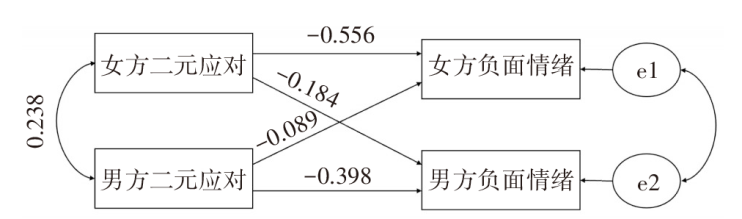
| 路径 | β | SE | CR | P |
|---|---|---|---|---|
| 女方负面情绪(Y1)←女方二元应对(X1) | -0.556 | 0.108 | -5.165 | <0.001 |
| 女方负面情绪(Y1)←男方二元应对(X2) | -0.089 | 0.058 | -1.521 | 0.128 |
| 男方负面情绪(Y2)←女方二元应对(X1) | -0.184 | 0.055 | -3.338 | <0.001 |
| 男方负面情绪(Y2)←男方二元应对(X2) | -0.398 | 0.067 | -5.929 | <0.001 |
| 路径 | β | SE | CR | P |
|---|---|---|---|---|
| 女方负面情绪(Y1)←女方二元应对(X1) | -0.556 | 0.108 | -5.165 | <0.001 |
| 女方负面情绪(Y1)←男方二元应对(X2) | -0.089 | 0.058 | -1.521 | 0.128 |
| 男方负面情绪(Y2)←女方二元应对(X1) | -0.184 | 0.055 | -3.338 | <0.001 |
| 男方负面情绪(Y2)←男方二元应对(X2) | -0.398 | 0.067 | -5.929 | <0.001 |
| [1] | Shingshetty L, Cameron NJ, Mclernon DJ, et al. Predictors of success after in vitro fertilization[J]. Fertil Steril, 2024, 121(5):742-751. doi: 10.1016/j.fertnstert.2024.03.003. |
| [2] | Braverman AM, Davoudian T, Levin IK, et al. Depression, anxiety, quality of life, and infertility: a global lens on the last decade of research[J]. Fertil Steril, 2024, 121(3):379-383. doi: 10.1016/j.fertnstert.2024.01.013. |
| [3] | Walker Z, Ernandez J, Lanes A, et al. The effects of male anxiety and depression on IVF outcomes[J]. Hum Reprod, 2023, 38(11):2119-2127. doi: 10.1093/humrep/dead179. |
| [4] | 陈奕铭, 杨丽萍, 王燕侠, 等. 某市新型冠状病毒肺炎疫情期间孕妇焦虑抑郁对妊娠结局的影响[J]. 中国计划生育和妇产科, 2022, 14(12):27-31. doi: 10.3969/j.issn.1674-4020.2022.12.07. |
| [5] | 马靖茹, 郝素芳, 谷向向, 等. 孕前焦虑和抑郁对妊娠期糖脂代谢指标水平、妊娠期并发症和妊娠结局的影响[J]. 广西医学, 2021, 43(22):2650-2653,2659. doi: 10.11675/j.issn.0253-4304.2021.22.03. |
| [6] |
Eisenberg ML, Esteves SC, Lamb DJ, et al. Male infertility[J]. Nat Rev Dis Primers, 2023, 9(1):49. doi: 10.1038/s41572-023-00459-w.
pmid: 37709866 |
| [7] | 张龙, 刘纪南, 冯玉慧. 部队官兵不孕不育问题分析与对策[J]. 海军医学杂志, 2016, 37(2):107-108,175. doi: 10.3969/j.issn.1009-0754.2016.02.005. |
| [8] | 闫素文, 孟培, 孙延芝, 等. 关于两地生活探亲夫妇不孕症诊断标准的探讨[J]. 中国实用妇科与产科杂志, 2000, 16(12):755-756. doi: 10.3969/j.issn.1005-2216.2000.12.024. |
| [9] | Landolt SA, Weitkamp K, Roth M, et al. Dyadic coping and mental health in couples: A systematic review[J]. Clin Psychol Rev, 2023, 106:102344. doi: 10.1016/j.cpr.2023.102344. |
| [10] |
Turcotte S, Robitaille H, Blair L, et al. The actor-partner interdependence model in shared decision-making: an illustrative example of its application to the physician-patient dyad in primary care consultations[J]. J Clin Epidemiol, 2019, 108:132-139. doi: 10.1016/j.jclinepi.2018.11.027.
pmid: 30529006 |
| [11] |
Chaves C, Canavarro MC, Moura-Ramos M. The Role of Dyadic Coping on the Marital and Emotional Adjustment of Couples With Infertility[J]. Fam Process, 2019, 58(2):509-523. doi: 10.1111/famp.12364.
pmid: 29709057 |
| [12] | Song X, Zhao J, Xiao Z, et al. The actor-partner interdependence model of fertility stress and marital quality among couples undergoing in vitro fertilization and embryo transfer: The mediating role of dyadic coping[J]. Stress Health, 2024, 40(6):e3483. doi: 10.1002/smi.3483. |
| [13] | 倪平, 陈京立, 刘娜. 护理研究中量性研究的样本量估计[J]. 中华护理杂志, 2010, 45(4):378-380. doi: 10.3761/j.issn.0254-1769.2010.04.037. |
| [14] |
Zung WW. A rating instrument for anxiety disorders[J]. Psychosomatics, 1971, 12(6):371-379. doi: 10.1016/S0033-3182(71)71479-0.
pmid: 5172928 |
| [15] |
Zung WW. A Self-Rating Depression Scale[J]. Arch Gen Psychiatry, 1965, 12:63-70. doi: 10.1001/archpsyc.1965.01720310065008.
pmid: 14221692 |
| [16] | Gmelch S, Bodenmann G, Meuwly N, et al. Dyadic Coping Inventory (DCI): A questionnaire assessing dyadic coping in couples[J]. Z Familienforsch, 2008, 20(2):185-202. |
| [17] | Xu F, Hilpert P, Randall AK, et al. Validation of the Dyadic Coping Inventory with Chinese couples: Factorial structure, measurement invariance, and construct validity[J]. Psychol Assess, 2016, 28(8):e127-140. doi: 10.1037/pas0000329. |
| [18] |
Moutzouri M, Sarantaki A, Koulierakis G, et al. Coping Strategies Associated with Emotional Adjustment during the Dyadic Experience of Infertility and Its Treatment: A Systematic Review[J]. J Mother Child, 2024, 28(1):61-69. doi: 10.34763/jmotherandchild.20242801.d-24-00013.
pmid: 39043203 |
| [19] | Péloquin K, Boucher S, Benoit Z, et al. "We're in this together": Attachment insecurities, dyadic coping strategies, and relationship satisfaction in couples involved in medically assisted reproduction[J]. J Marital Fam Ther, 2023, 49(1):92-110. doi: 10.1111/jmft.12608. |
| [20] |
Ye H, Zhao J, Zou Y, et al. Correlations among hope, fertility quality of life and negative emotions for couples undergoing their first in vitro fertilization-embryo transfer: a cross-sectional analysis[J]. Reprod Health, 2025, 22(1):10. doi: 10.1186/s12978-025-01954-x.
pmid: 39876018 |
| [21] | 裴梦月. 不孕症夫妇二元应对与焦虑、抑郁的关系研究[D]. 兰州: 兰州大学, 2023. doi:10.27204/d.cnki.glzhu.2023.003555. |
| [22] | 陈拓, 吴向然. 个体化与技术共谋:青年异地夫妻数字化亲密研究[J]. 东南学术, 2023, 25(4):186-196. doi: 10.13658/j.cnki.sar.2023.04.009. |
| [1] | CHEN Yan, WANG Shan-lin, MA Zhen-hua, GAO Hui, ZHOU Rong, DING Ming-ming, XIANG Min. Analysis of Influencing Factors of Adverse Psychological State of Primipara in Late Pregnancy and Its Impact on Maternal and Infant Outcome [J]. Journal of International Reproductive Health/Family Planning, 2026, 45(4): 270-275. |
| [2] | YUAN Xia, HAN Xiao-fang, LI Hong. Precise Application of Short-Term Insemination Combined with Early Rescue Intracytoplasmic Sperm Injection [J]. Journal of International Reproductive Health/Family Planning, 2026, 45(4): 311-317. |
| [3] | ZHU Yan-jun, WEN Yi, GONG Fei. Transabdominal Ultrasound-Guided Oocyte Retrieval in Ovulation Induction Cycle: A Report of Two Cases [J]. Journal of International Reproductive Health/Family Planning, 2026, 45(3): 218-223. |
| [4] | KUANG Qian-qian, ZHAO Xian, ZHANG Ning, XI Jin, YUAN Rong-li, LIU Qi, WANG Meng-jing. Research Progress on the Effect and Mechanism of Acupuncture Intervention at Different Stages of IVF-ET [J]. Journal of International Reproductive Health/Family Planning, 2026, 45(3): 247-252. |
| [5] | XU Dan, ZHOU Qiao, JI Hui. Effects of Endometrial Preparation Protocols on the Live Birth Outcome after Endometrial Polypectomy [J]. Journal of International Reproductive Health/Family Planning, 2026, 45(1): 1-5. |
| [6] | ZHOU Jun, PEI Jing-liang, PANG Hai-yan, ZHANG Mao-xiang, TIAN Yan-ya, WANG Gui-ling. A Case of Male Infertility Resulting from A Complex Chromosomal Rearrangement Involving Seven Chromosomes [J]. Journal of International Reproductive Health/Family Planning, 2026, 45(1): 23-27. |
| [7] | HUANG Ru, JIN Meng-han, ZHONG Yu-nong, WANG Ke-han, MENG Qing-xia. Research Progress on DNA Methylation of Gametes, Embryos and Offspring from Assisted Reproductive Technology [J]. Journal of International Reproductive Health/Family Planning, 2026, 45(1): 45-48. |
| [8] | TONG Chen-ye, QIAN Wen, HUANG Li-min, JI Hong, NI Ying. The Current Situation of Appropriate Medication in IVF Patients and Its Impact on Pregnancy Outcomes [J]. Journal of International Reproductive Health/Family Planning, 2025, 44(6): 441-447. |
| [9] | XU Jin-jin, ZHENG Li. Cross-Lagged Analysis of Maternal Dyadic Coping and Psychosomatic Symptom Clusters [J]. Journal of International Reproductive Health/Family Planning, 2025, 44(6): 448-452. |
| [10] | YANG Jing, JI Dong-mei. Progress in Enucleated Oocyte Donation and Its Clinical Application [J]. Journal of International Reproductive Health/Family Planning, 2025, 44(6): 496-500. |
| [11] | CUI Yu-fei, JIA Dong-ling, WANG Li-yan, LI Fu-lan, LIU Hui-hui, ZHANG Li-hong, HU Rong, HU Jun-ping. Mindfulness-Based Interventions in Patients Undergoing In Vitro Fertilization-Embryo Transfer: A Scoping Review [J]. Journal of International Reproductive Health/Family Planning, 2025, 44(5): 371-376. |
| [12] | YU Jian-nan, GAO Zhu-wei, GE Hang, LIU Yang, SHI Bai-chao, BAI Yu-xin, GAO Jing-shu, WANG Yu, WU Xiao-ke. The Potential Therapeutic Role of Quercetin in Polycystic Ovary Syndrome [J]. Journal of International Reproductive Health/Family Planning, 2025, 44(5): 393-398. |
| [13] | ZHANG Qi-qi, YAN Jun, ZHANG Tong, LIU Zhen-zhen, ZHOU Xiao-kun, JIANG Ai-fang. A Case of Successful Delivery through IVF-ET in An Infertile Patient with Essential Thrombocythemia [J]. Journal of International Reproductive Health/Family Planning, 2025, 44(4): 293-296. |
| [14] | HONG Pei, LI Cai-hua, ZHANG Xiao-hui, WEI Zhao-lian, CAO Yun-xia, JI Dong-mei. A Case of Successful Assisted Pregnancy for An Infertile Woman with Pelvic Tuberculosis [J]. Journal of International Reproductive Health/Family Planning, 2025, 44(4): 297-300. |
| [15] | LI Miao, LI Xi-xi, CHENG Min, LIU Hang-cheng. Detection Rate of Depression Symptoms during in Vitro Fertilization-Embryo Transfer Treatment in Chinese Infertile Women: A Meta-Analysis [J]. Journal of International Reproductive Health/Family Planning, 2025, 44(3): 184-191. |
| Viewed | ||||||
|
Full text |
|
|||||
|
Abstract |
|
|||||
