
Journal of International Reproductive Health/Family Planning ›› 2026, Vol. 45 ›› Issue (3): 184-189.doi: 10.12280/gjszjk.20260042
• Original Article • Previous Articles Next Articles
FANG Jin, YANG Hui, WANG Zhi( )
)
Received:2026-01-27
Published:2026-05-15
Online:2026-06-02
Contact:
WANG Zhi, E-mail: FANG Jin, YANG Hui, WANG Zhi. Analysis of the Impact of Lymphadenectomy on Survival in FIGO Ⅱ-Ⅳ Ovarian Mucinous Carcinoma Based on the SEER Database[J]. Journal of International Reproductive Health/Family Planning, 2026, 45(3): 184-189.
Add to citation manager EndNote|Ris|BibTeX
| 特征 | 未行淋巴结清扫组 (386例) | 淋巴结清扫组 (340例) | χ2 | P |
|---|---|---|---|---|
| 种族 | - | 0.373* | ||
| 白种人 | 296(76.7) | 271(79.7) | ||
| 黑种人 | 48(12.4) | 30(8.8) | ||
| 其他 | 39(10.1) | 38(11.2) | ||
| 未知 | 3(0.8) | 1(0.3) | ||
| 年龄 | 8.203 | 0.004 | ||
| ≤ 55岁 | 160(41.5) | 178(52.4) | ||
| >55岁 | 226(58.5) | 162(47.6) | ||
| FIGO分期 | 17.915 | <0.001 | ||
| Ⅱ期 | 67(17.4) | 99(29.1) | ||
| Ⅲ期 | 186(48.2) | 160(47.1) | ||
| Ⅳ期 | 133(34.4) | 81(23.8) | ||
| 病理分级 | 2.923 | 0.404 | ||
| Ⅰ级 | 60(15.5) | 53(15.6) | ||
| Ⅱ级 | 85(22.0) | 89(26.2) | ||
| Ⅲ级 | 75(19.5) | 71(20.9) | ||
| 未知 | 166(43.0) | 127(37.4) | ||
| 肿瘤侧别 | 10.677 | 0.001 | ||
| 单侧 | 240(62.2) | 251(73.8) | ||
| 双侧 | 146(37.8) | 89(26.2) | ||
| 化疗 | 4.286 | 0.038 | ||
| 否/未知 | 133(34.5) | 92(27.1) | ||
| 是 | 253(65.5) | 248(72.9) |
| 特征 | 未行淋巴结清扫组 (386例) | 淋巴结清扫组 (340例) | χ2 | P |
|---|---|---|---|---|
| 种族 | - | 0.373* | ||
| 白种人 | 296(76.7) | 271(79.7) | ||
| 黑种人 | 48(12.4) | 30(8.8) | ||
| 其他 | 39(10.1) | 38(11.2) | ||
| 未知 | 3(0.8) | 1(0.3) | ||
| 年龄 | 8.203 | 0.004 | ||
| ≤ 55岁 | 160(41.5) | 178(52.4) | ||
| >55岁 | 226(58.5) | 162(47.6) | ||
| FIGO分期 | 17.915 | <0.001 | ||
| Ⅱ期 | 67(17.4) | 99(29.1) | ||
| Ⅲ期 | 186(48.2) | 160(47.1) | ||
| Ⅳ期 | 133(34.4) | 81(23.8) | ||
| 病理分级 | 2.923 | 0.404 | ||
| Ⅰ级 | 60(15.5) | 53(15.6) | ||
| Ⅱ级 | 85(22.0) | 89(26.2) | ||
| Ⅲ级 | 75(19.5) | 71(20.9) | ||
| 未知 | 166(43.0) | 127(37.4) | ||
| 肿瘤侧别 | 10.677 | 0.001 | ||
| 单侧 | 240(62.2) | 251(73.8) | ||
| 双侧 | 146(37.8) | 89(26.2) | ||
| 化疗 | 4.286 | 0.038 | ||
| 否/未知 | 133(34.5) | 92(27.1) | ||
| 是 | 253(65.5) | 248(72.9) |
| 特征 分组 | 单因素分析 | 多因素分析 | ||||
|---|---|---|---|---|---|---|
| HR | 95%CI | P | aHR | 95%CI | P | |
| 年龄 | ||||||
| ≤ 55岁 | 1 | 1 | ||||
| >55岁 | 1.34 | 1.12~1.60 | 0.001 | 1.37 | 1.14~1.64 | <0.001 |
| FIGO分期 | ||||||
| Ⅱ期 | 1 | 1 | ||||
| Ⅲ期 | 3.17 | 2.38~4.23 | <0.001 | 3.03 | 2.26~4.06 | <0.001 |
| Ⅳ期 | 5.33 | 3.95~7.21 | <0.001 | 4.97 | 3.65~6.76 | <0.001 |
| 病理分级 | ||||||
| Ⅰ级 | 1 | 1 | ||||
| Ⅱ级 | 1.45 | 1.08~1.93 | 0.012 | 1.53 | 1.14~2.05 | 0.004 |
| Ⅲ级 | 1.87 | 1.40~2.50 | <0.001 | 1.90 | 1.42~2.55 | <0.001 |
| 未知 | 1.19 | 0.90~1.57 | 0.228 | 1.11 | 0.84~1.47 | 0.450 |
| 肿瘤侧别 | ||||||
| 单侧 | 1 | 1 | ||||
| 双侧 | 1.68 | 1.40~2.01 | <0.001 | 1.24 | 1.03~1.49 | 0.024 |
| 淋巴结清扫术 | ||||||
| 否 | 1 | 1 | ||||
| 是 | 0.50 | 0.42~0.61 | <0.001 | 0.58 | 0.48~0.70 | <0.001 |
| 化疗 | ||||||
| 否/未知 | 1 | 1 | ||||
| 是 | 0.73 | 0.61~0.89 | 0.001 | 0.66 | 0.54~0.80 | <0.001 |
| 特征 分组 | 单因素分析 | 多因素分析 | ||||
|---|---|---|---|---|---|---|
| HR | 95%CI | P | aHR | 95%CI | P | |
| 年龄 | ||||||
| ≤ 55岁 | 1 | 1 | ||||
| >55岁 | 1.34 | 1.12~1.60 | 0.001 | 1.37 | 1.14~1.64 | <0.001 |
| FIGO分期 | ||||||
| Ⅱ期 | 1 | 1 | ||||
| Ⅲ期 | 3.17 | 2.38~4.23 | <0.001 | 3.03 | 2.26~4.06 | <0.001 |
| Ⅳ期 | 5.33 | 3.95~7.21 | <0.001 | 4.97 | 3.65~6.76 | <0.001 |
| 病理分级 | ||||||
| Ⅰ级 | 1 | 1 | ||||
| Ⅱ级 | 1.45 | 1.08~1.93 | 0.012 | 1.53 | 1.14~2.05 | 0.004 |
| Ⅲ级 | 1.87 | 1.40~2.50 | <0.001 | 1.90 | 1.42~2.55 | <0.001 |
| 未知 | 1.19 | 0.90~1.57 | 0.228 | 1.11 | 0.84~1.47 | 0.450 |
| 肿瘤侧别 | ||||||
| 单侧 | 1 | 1 | ||||
| 双侧 | 1.68 | 1.40~2.01 | <0.001 | 1.24 | 1.03~1.49 | 0.024 |
| 淋巴结清扫术 | ||||||
| 否 | 1 | 1 | ||||
| 是 | 0.50 | 0.42~0.61 | <0.001 | 0.58 | 0.48~0.70 | <0.001 |
| 化疗 | ||||||
| 否/未知 | 1 | 1 | ||||
| 是 | 0.73 | 0.61~0.89 | 0.001 | 0.66 | 0.54~0.80 | <0.001 |
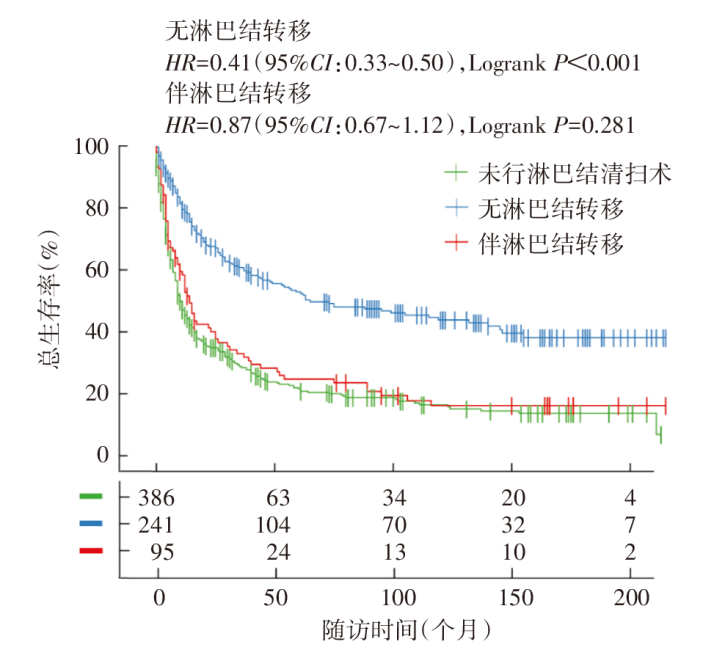
| 特征 | 无淋巴结转移组 (241例) | 伴淋巴结转移组 (95例) | χ2 | P |
|---|---|---|---|---|
| 年龄 | 1.653 | 0.199 | ||
| ≤55岁 | 119(49.4) | 55(57.9) | ||
| >55岁 | 122(50.6) | 40(42.1) | ||
| FIGO分期 | 54.222 | <0.001 | ||
| Ⅱ期 | 96(39.8) | 0(0.0) | ||
| Ⅲ期 | 93(38.6) | 67(70.5) | ||
| Ⅳ期 | 52(21.6) | 28(29.5) | ||
| 病理分级 | 6.045 | 0.109 | ||
| Ⅰ级 | 39(16.2) | 14(14.7) | ||
| Ⅱ级 | 66(27.4) | 22(23.1) | ||
| Ⅲ级 | 42(17.4) | 28(29.6) | ||
| 未知 | 94(39.0) | 31(32.6) | ||
| 肿瘤侧别 | 2.397 | 0.122 | ||
| 单侧 | 184(76.3) | 64(67.4) | ||
| 双侧 | 57(23.7) | 31(32.6) | ||
| 化疗 | 0.209 | 0.648 | ||
| 否/未知 | 66(27.4) | 23(24.2) | ||
| 是 | 175(72.6) | 72(75.8) | ||
| 切除淋巴结数量 | 1.550 | 0.213 | ||
| ≤ 3个 | 74(30.7) | 22(23.2) | ||
| >3个 | 167(69.3) | 73(76.8) |
| 特征 | 无淋巴结转移组 (241例) | 伴淋巴结转移组 (95例) | χ2 | P |
|---|---|---|---|---|
| 年龄 | 1.653 | 0.199 | ||
| ≤55岁 | 119(49.4) | 55(57.9) | ||
| >55岁 | 122(50.6) | 40(42.1) | ||
| FIGO分期 | 54.222 | <0.001 | ||
| Ⅱ期 | 96(39.8) | 0(0.0) | ||
| Ⅲ期 | 93(38.6) | 67(70.5) | ||
| Ⅳ期 | 52(21.6) | 28(29.5) | ||
| 病理分级 | 6.045 | 0.109 | ||
| Ⅰ级 | 39(16.2) | 14(14.7) | ||
| Ⅱ级 | 66(27.4) | 22(23.1) | ||
| Ⅲ级 | 42(17.4) | 28(29.6) | ||
| 未知 | 94(39.0) | 31(32.6) | ||
| 肿瘤侧别 | 2.397 | 0.122 | ||
| 单侧 | 184(76.3) | 64(67.4) | ||
| 双侧 | 57(23.7) | 31(32.6) | ||
| 化疗 | 0.209 | 0.648 | ||
| 否/未知 | 66(27.4) | 23(24.2) | ||
| 是 | 175(72.6) | 72(75.8) | ||
| 切除淋巴结数量 | 1.550 | 0.213 | ||
| ≤ 3个 | 74(30.7) | 22(23.2) | ||
| >3个 | 167(69.3) | 73(76.8) |
| [1] | Borella F, Mitidieri M, Cosma S, et al. Update on Prognostic and Predictive Markers in Mucinous Ovarian Cancer[J]. Cancers(Basel), 2023, 15(4):1172. doi: 10.3390/cancers15041172. |
| [2] |
Seidman JD, Horkayne-Szakaly I, Haiba M, et al. The histologic type and stage distribution of ovarian carcinomas of surface epithelial origin[J]. Int J Gynecol Pathol, 2004, 23(1):41-44. doi: 10.1097/01.pgp.0000101080.35393.16.
pmid: 14668549 |
| [3] | Maiorano M, Maiorano BA, Cormio G, et al. Mucinous Ovarian Carcinoma: Integrating Molecular Stratification into Surgical and Therapeutic Management[J]. Biomedicines, 2025, 13(5):1198. doi: 10.3390/biomedicines13051198. |
| [4] | 张珩, 孔为民. 原发性卵巢黏液性癌治疗的现状及进展[J]. 中华妇产科杂志, 2021, 56(3):226-229. doi: 10.3760/cma.j.cn112141-20200723-00598. |
| [5] |
Algera MD, Van de Vijver KK, van Driel WJ, et al. Outcomes of patients with early stage mucinous ovarian carcinoma: a Dutch population-based cohort study comparing expansile and infiltrative subtypes[J]. Int J Gynecol Cancer, 2024, 34(5):722-729. doi: 10.1136/ijgc-2023-004955.
pmid: 38460968 |
| [6] | Morice P, Gouy S, Leary A. Mucinous Ovarian Carcinoma[J]. N Engl J Med, 2019, 380(13):1256-1266. doi: 10.1056/NEJMra1813254. |
| [7] |
Bamias A, Sotiropoulou M, Zagouri F, et al. Prognostic evaluation of tumour type and other histopathological characteristics in advanced epithelial ovarian cancer, treated with surgery and paclitaxel/carboplatin chemotherapy: cell type is the most useful prognostic factor[J]. Eur J Cancer, 2012, 48(10):1476-1483. doi: 10.1016/j.ejca.2011.09.023.
pmid: 22047635 |
| [8] | Przywara G, Biegańska O, Biczak E, et al. Recent Therapies and Biomarkers in Mucinous Ovarian Carcinoma[J]. Cells, 2025, 14(16):1232. doi: 10.3390/cells14161232. |
| [9] | Lheureux S, Gourley C, Vergote I, et al. Epithelial ovarian cancer[J]. The Lancet, 2019, 393(10177):1240-1253. doi: 10.1016/S0140-6736(18)32552-2. |
| [10] |
Harter P, Gnauert K, Hils R, et al. Pattern and clinical predictors of lymph node metastases in epithelial ovarian cancer[J]. Int J Gynecol Cancer, 2007, 17(6):1238-1244. doi: 10.1111/j.1525-1438.2007.00931.x.
pmid: 17433064 |
| [11] |
Hada T, Miyamoto M, Ishibashi H, et al. Survival and biomarker analysis for ovarian mucinous carcinoma according to invasive patterns: retrospective analysis and review literature[J]. J Ovarian Res, 2021, 14(1):33. doi: 10.1186/s13048-021-00783-3.
pmid: 33583413 |
| [12] | Harter P, Sehouli J, Lorusso D, et al. A Randomized Trial of Lymphadenectomy in Patients with Advanced Ovarian Neoplasms[J]. N Engl J Med, 2019, 380(9):822-832. doi: 10.1056/NEJMoa1808424. |
| [13] |
Heyward QD, Nasioudis D, Cory L, et al. Lymphadenectomy for early-stage mucinous ovarian carcinoma[J]. Int J Gynecol Cancer, 2021, 31(1):104-109. doi: 10.1136/ijgc-2020-001817.
pmid: 33243777 |
| [14] | Hoogendam JP, Vlek CA, Witteveen PO, et al. Surgical lymph node assessment in mucinous ovarian carcinoma staging: a systematic review and meta-analysis[J]. BJOG, 2017, 124(3):370-378. doi: 10.1111/1471-0528.14226. |
| [15] | Morice P, Joulie F, Camatte S, et al. Lymph node involvement in epithelial ovarian cancer: analysis of 276 pelvic and paraaortic lymphadenectomies and surgical implications[J]. J Am Coll Surg, 2003, 197(2):198-205. doi: 10.1016/S1072-7515(03)00234-5. |
| [16] |
Ataseven B, Grimm C, Harter P, et al. Prognostic value of lymph node ratio in patients with advanced epithelial ovarian cancer[J]. Gynecol Oncol, 2014, 135(3):435-440. doi: 10.1016/j.ygyno.2014.10.003.
pmid: 25312398 |
| [17] | Maggioni A, Benedetti Panici P, Dell'Anna T, et al. Randomised study of systematic lymphadenectomy in patients with epithelial ovarian cancer macroscopically confined to the pelvis[J]. Br J Cancer, 2006, 95(6):699-704. doi: 10.1038/sj.bjc.6603323. |
| [18] |
Ditto A, Martinelli F, Reato C, et al. Systematic para-aortic and pelvic lymphadenectomy in early stage epithelial ovarian cancer: a prospective study[J]. Ann Surg Oncol, 2012, 19(12):3849-3855. doi: 10.1245/s10434-012-2439-7.
pmid: 22707110 |
| [19] |
Muyldermans K, Moerman P, Amant F, et al. Primary invasive mucinous ovarian carcinoma of the intestinal type: importance of the expansile versus infiltrative type in predicting recurrence and lymph node metastases[J]. Eur J Cancer, 2013, 49(7):1600-1608. doi: 10.1016/j.ejca.2012.12.004.
pmid: 23321546 |
| [20] |
Addley S, Asher V, Kirke R, et al. What are the implications of radiologically abnormal cardiophrenic lymph nodes in advanced ovarian cancer? An analysis of tumour burden, surgical complexity, same-site recurrence and overall survival[J]. Eur J Surg Oncol, 2022, 48(12):2531-2538. doi: 10.1016/j.ejso.2022.06.006.
pmid: 35718677 |
| [21] | Benoit L, Koual M, Le Frère-Belda MA, et al. Risks and benefits of systematic lymphadenectomy during interval debulking surgery for advanced high grade serous ovarian cancer[J]. Eur J Surg Oncol, 2022, 48(1):275-282. doi: 10.1016/j.ejso.2021.10.027. |
| [1] | XIE Xiao-bing, HOU Tao. Complete Androgen Insensitivity Syndrome Complicated with Bilateral Ovarian Gynandroblastoma: A Case Report [J]. Journal of International Reproductive Health/Family Planning, 2026, 45(3): 209-213. |
| [2] | DAI Qi-sha, ZHANG Tian-hui, ZENG Wei-hong, HUANG Li-shan, LIU Hao-chang, YANG Hai-kun. Ovarian Nongestational Choriocarcinoma Presenting as Acute Abdomen: A Case Report [J]. Journal of International Reproductive Health/Family Planning, 2026, 45(3): 214-217. |
| [3] | WANG Si-yao, HU Xiao-hong, LING Fei-fei, LIU Chang. A Case of Elevated CA125 and Meigs Syndrome in An Adolescent Ovarian Fibroma [J]. Journal of International Reproductive Health/Family Planning, 2025, 44(6): 471-474. |
| [4] | XIE Jiu-mei, WANG Yu, CHEN Xiang-nan, ZHANG Li-qian, WU Xiao-ke. Research Progress on Resveratrol in Gynecologic Malignant Tumor [J]. Journal of International Reproductive Health/Family Planning, 2025, 44(6): 524-528. |
| [5] | LIU Qin, ZHENG Rong. A Case Report of Ovarian Steroid Cell Tumor-Not Otherwise Specified with Ascites [J]. Journal of International Reproductive Health/Family Planning, 2025, 44(5): 388-392. |
| [6] | ZHANG Li-qian, LU Run-guo, WANG Yu, SHI Bai-chao, WU Xiao-ke. The Mechanism of Active Components of Traditional Chinese Medicine in Treating Ovarian Cancer by PI3K/Akt Signaling [J]. Journal of International Reproductive Health/Family Planning, 2025, 44(5): 434-440. |
| [7] | CHEN Jian-chao, WANG Hua, DONG Qu-long. Diagnosis and Treatment of Bilateral Pregnancy Luteoma: A Case Report [J]. Journal of International Reproductive Health/Family Planning, 2025, 44(4): 307-311. |
| [8] | SONG Meng-meng, CHEN Fang, BAO Xiang-xiang, TIAN Xin-li. Research Progress of PRMT5 in Gynecological Malignant Tumors [J]. Journal of International Reproductive Health/Family Planning, 2025, 44(2): 171-176. |
| [9] | LIU Shu-jie, LI Ming-ze, ZHANG Hai-yan. Modium-Low Differentiation Sertoli-Leydig Cell Tumor of the Ovary: A Case Report and Literature Review [J]. Journal of International Reproductive Health/Family Planning, 2024, 43(3): 207-211. |
| [10] | OU Xiao-yu, ZENG Yu-hua, CHEN Yan-fen, XIE Lin-ling, ZENG Lei, LU Ru-ling. A Case Report of MRKH Syndrome Complicated with Ovarian Malignant Tumor [J]. Journal of International Reproductive Health/Family Planning, 2024, 43(2): 121-126. |
| [11] | CHU Man-wei, CHEN Huan-huan, WANG Qian, WANG Yi-wen, LI Dan, YANG Shu-jun, ZHANG Cui-lian. The Mechanism of MiR-20a in Common Gynecological Malignant Tumors [J]. Journal of International Reproductive Health/Family Planning, 2024, 43(2): 172-176. |
| [12] | GAO Ya-ting, WANG Fang, MA Jian-hong, MA Yi-tong, LIU Chang. Research Progress of Cuproptosis in Gynecologic Malignant Tumor [J]. Journal of International Reproductive Health/Family Planning, 2024, 43(1): 74-78. |
| [13] | MA Yan-hong, ZHAN Rui. Pathological Characteristics of 6 Cases of Ovarian Brenner Tumor [J]. Journal of International Reproductive Health/Family Planning, 2023, 42(6): 446-449. |
| [14] | AN Rong, WANG Xiao-hui. Ovarian Primitive Neuroectodermal Tumor: A Case Report and Literature Review [J]. Journal of International Reproductive Health/Family Planning, 2023, 42(5): 376-379. |
| [15] | WANG Min, AN Rong, ZHANG Jing, QI Qi, XU Fei-xue. Synchronous Cervical Adenocarcinoma Combined with Ovarian Cancer: A Case Report and Literature Review [J]. Journal of International Reproductive Health/Family Planning, 2023, 42(5): 387-391. |
| Viewed | ||||||
|
Full text |
|
|||||
|
Abstract |
|
|||||
