
国际生殖健康/计划生育杂志 ›› 2026, Vol. 45 ›› Issue (4): 311-317.doi: 10.12280/gjszjk.20260080
苑霞, 韩晓芳, 李弘( )
)
收稿日期:2026-02-14
出版日期:2026-07-15
发布日期:2026-07-27
通讯作者:
李弘
E-mail:lh1461@sina.com
YUAN Xia, HAN Xiao-fang, LI Hong()
Received:2026-02-14
Published:2026-07-15
Online:2026-07-27
Contact:
LI Hong
E-mail:lh1461@sina.com
摘要:
常规体外受精(conventional in vitro fertilization,c-IVF)是目前临床应用最广泛的辅助生殖技术之一,但其5%~15%的完全受精失败(total fertilization failure,TFF)率仍是不可忽视的临床难题,可显著降低累积活产率,直接引发周期取消与胚胎资源匮乏,加重患者负担。短时受精联合早期补救卵胞质内单精子注射(early rescue intracytoplasmic sperm injection,E-RICSI)是预防c-IVF周期TFF的核心策略,通过3~6 h精卵共孵育联合第二极体排出情况监测,可及时干预受精障碍,规避卵母细胞体外老化风险,同时保留自然受精优势。经循证证实该技术可将TFF率降至1%以下,维持良好的正常受精率和优质囊胚形成率,其临床妊娠、累积活产结局及新生儿安全性均与常规卵胞质内单精子注射(intracytoplasmic sperm injection,ICSI)相当,兼具良好的卫生经济学效益。但该技术目前仍存在指征不统一、风险分层精准度不足、应用不规范等问题。综述该技术的循证医学研究、风险分层体系与临床决策路径,旨在为其规范化、精准化临床应用提供循证参考。
苑霞, 韩晓芳, 李弘. 短时受精联合早期补救卵胞质内单精子注射的精准应用[J]. 国际生殖健康/计划生育杂志, 2026, 45(4): 311-317.
YUAN Xia, HAN Xiao-fang, LI Hong. Precise Application of Short-Term Insemination Combined with Early Rescue Intracytoplasmic Sperm Injection[J]. Journal of International Reproductive Health/Family Planning, 2026, 45(4): 311-317.
| 风险类别 | 具体指标 | OR(95%CI) | 证据 质量 | 证据 来源 |
|---|---|---|---|---|
| 男性因素 | 精液处理后总前向运动 精子数<1.0×10⁶ | 6.8(3.4~12.1) | 中 | [ |
| 精子正常形态率<4%(严格标准) | 3.1(1.7~5.5) | 中 | [ | |
| 精子DNA碎片指数>30% | 3.5(2.0~6.1) | 中 | [ | |
| 女性因素 | 成熟卵数≤5个 | 5.2(3.0~8.6) | 高 | [ |
| 年龄≥38岁 | 3.2(1.9~5.7) | 中 | [ | |
| 子宫内膜异位症 | 2.4(1.4~4.1) | 中 | [ | |
| 既往史 | 既往TFF或低受精率(<30%) | 9.7(5.1~16.8) | 高 | [ |
表1 c-IVF周期TFF的风险因素汇总
| 风险类别 | 具体指标 | OR(95%CI) | 证据 质量 | 证据 来源 |
|---|---|---|---|---|
| 男性因素 | 精液处理后总前向运动 精子数<1.0×10⁶ | 6.8(3.4~12.1) | 中 | [ |
| 精子正常形态率<4%(严格标准) | 3.1(1.7~5.5) | 中 | [ | |
| 精子DNA碎片指数>30% | 3.5(2.0~6.1) | 中 | [ | |
| 女性因素 | 成熟卵数≤5个 | 5.2(3.0~8.6) | 高 | [ |
| 年龄≥38岁 | 3.2(1.9~5.7) | 中 | [ | |
| 子宫内膜异位症 | 2.4(1.4~4.1) | 中 | [ | |
| 既往史 | 既往TFF或低受精率(<30%) | 9.7(5.1~16.8) | 高 | [ |
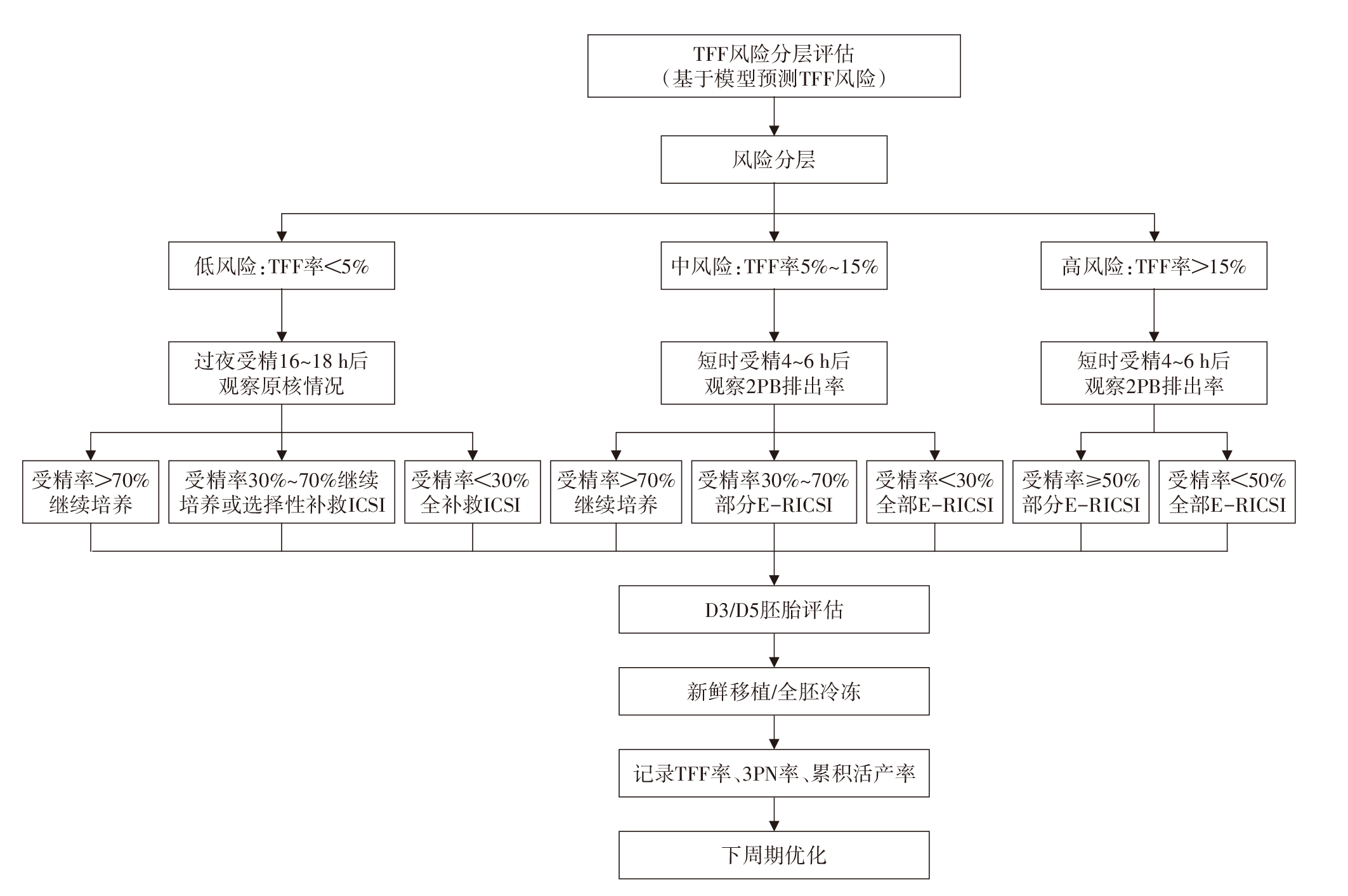
图1 风险分层下短时受精联合E-RICSI临床决策路径
| [1] | Katagiri Y, Jwa SC, Kuwahara A, et al. Assisted reproductive technology in Japan: A summary report for 2020 by the ethics Committee of the Japan Society of obstetrics and gynecology[J]. Reprod Med Biol, 2023, 22(1):e12494. doi: 10.1002/rmb2.12494. |
| [2] | Hu L, Bu Z, Huang G, et al. Assisted Reproductive Technology in China: Results Generated From Data Reporting System by CSRM From 2013 to 2016[J]. Front Endocrinol(Lausanne), 2020, 11:458. doi: 10.3389/fendo.2020.00458. |
| [3] |
Wang Y, Li R, Yang R, et al. Intracytoplasmic sperm injection versus conventional in-vitro fertilisation for couples with infertility with non-severe male factor: a multicentre, open-label, randomised controlled trial[J]. Lancet, 2024, 403(10430):924-934. doi: 10.1016/S0140-6736(23)02416-9.
pmid: 38330980 |
| [4] | Berntsen S, Zedeler A, Nøhr B, et al. IVF versus ICSI in patients without severe male factor infertility: a randomized clinical trial[J]. Nat Med, 2025, 31(6):1939-1948. doi: 10.1038/s41591-025-03621-x. |
| [5] |
Dang VQ, Vuong LN, Luu TM, et al. Intracytoplasmic sperm injection versus conventional in-vitro fertilisation in couples with infertility in whom the male partner has normal total sperm count and motility: an open-label, randomised controlled trial[J]. Lancet, 2021, 397(10284):1554-1563. doi: 10.1016/S0140-6736(21)00535-3.
pmid: 33894833 |
| [6] | European IVF Monitoring Consortium (EIM) for the European Society of Human Reproduction and Embryology (ESHRE), Smeenk J, Wyns C, et al. ART in Europe, 2020: results generated from European registries by ESHRE[J]. Hum Reprod, 2025, 40(11):2038-2055. doi: 10.1093/humrep/deaf179. |
| [7] |
Beck-Fruchter R, Lavee M, Weiss A, et al. Rescue intracytoplasmic sperm injection: a systematic review[J]. Fertil Steril, 2014, 101(3):690-698. doi: 10.1016/j.fertnstert.2013.12.004.
pmid: 24444597 |
| [8] | Zhang X, Wang Y, Yang J, et al. The clinical value of short-term insemination: a retrospective analysis of 3496 patients[J]. BMC Pregnancy Childbirth, 2025, 25(1):30. doi: 10.1186/s12884-025-07151-9. |
| [9] | Jiang Y, Jin L, Huang B, et al. Cumulative live birth rate and neonatal outcomes after early rescue ICSI: a propensity score matching analysis[J]. Hum Reprod Open, 2023, 2023(4):hoad046. doi: 10.1093/hropen/hoad046. |
| [10] | 中国医师协会生殖医学专业委员会. 常规体外受精中国专家共识(2024年)[J]. 中华生殖与避孕杂志, 2024, 44(3):219-228. doi: 10.3760/cma.j.cn101441-20231225-00376. |
| [11] | ESHRE Guideline Group on Ovarian Stimulation, Ata B, Bosch E, et al. ESHRE guideline: ovarian stimulation for IVF/ICSI: an update in 2025[J]. Hum Reprod, 2026, 41(4):498-514. doi: 10.1093/humrep/deag018. |
| [12] |
Practice Committees of the American Society for Reproductive Medicine and the Society for Assisted Reproductive Technology. Electronic address: asrm@asrm.org. Intracytoplasmic sperm injection (ICSI) for non-male factor indications: a committee opinion[J]. Fertil Steril, 2020, 114(2):239-245. doi: 10.1016/j.fertnstert.2020.05.032.
pmid: 32654822 |
| [13] | Fan Y, Wu Z, Peng F, et al. Brief and long co-incubation of sperm and oocytes for in vitro fertilization: a meta-analysis of randomized controlled trials[J]. BMC Pregnancy Childbirth, 2023, 23(1):200. doi: 10.1186/s12884-023-05490-z. |
| [14] | Jiang L, Qian Y, Chen X, et al. Effect of early rescue ICSI and split IVF-ICSI in preventing low fertilization rate during the first ART cycle: A real-world retrospective cohort study[J]. Reprod Med Biol, 2022, 21(1):e12420. doi: 10.1002/rmb2.12420. |
| [15] | Chen L, Zhou H, Liu X, et al. Cycle Characteristics and Pregnancy Outcomes of Early Rescue Intracytoplasmic Sperm Injection Cycles in Normal and Hyper-Ovarian Response Women: A Six-Year Retrospective Study[J]. J Clin Med, 2023, 12(5):1993. doi: 10.3390/jcm12051993. |
| [16] |
Zeng J, Yao Z, Zhang Y, et al. Fertilization and neonatal outcomes after early rescue intracytoplasmic sperm injection: a retrospective analysis of 16,769 patients[J]. Arch Gynecol Obstet, 2022, 306(1):249-258. doi: 10.1007/s00404-022-06445-z.
pmid: 35380279 |
| [17] |
Chen C, Kattera S. Rescue ICSI of oocytes that failed to extrude the second polar body 6 h post-insemination in conventional IVF[J]. Hum Reprod, 2003, 18(10):2118-2121. doi: 10.1093/humrep/deg325.
pmid: 14507831 |
| [18] | 张宁媛, 孙海翔, 胡娅莉, 等. 短时受精联合早期补救性卵细胞胞质内单精子注射在完全受精失败周期的临床应用[J]. 中华男科学杂志, 2009, 15(6):538-541. doi: 10.13263/j.cnki.nja. 2009.06.020. |
| [19] | Ovarian Stimulation T, Bosch E, Broer S, et al. ESHRE guideline: ovarian stimulation for IVF/ICSI[J]. Hum Reprod Open, 2020, 2020(2):hoaa009. doi: 10.1093/hropen/hoaa009. |
| [20] | Jiang X, Cai J, Liu L, et al. Predicting the unexpected total fertilization failure in conventional in vitro fertilization cycles: What is the role of semen quality?[J]. Front Cell Dev Biol, 2023, 11:1133512. doi: 10.3389/fcell.2023.1133512. |
| [21] |
Wang H, Pan H, Xu Z, et al. Development of a single-center predictive model for conventional in vitro fertilization outcomes excluding total fertilization failure: implications for protocol selection[J]. J Ovarian Res, 2025, 18(1):138. doi: 10.1186/s13048-025-01728-w.
pmid: 40605088 |
| [22] |
Marinaro JA. Sperm DNA fragmentation and its interaction with female factors[J]. Fertil Steril, 2023, 120(4):715-719. doi: 10.1016/ j.fertnstert.2023.06.001.
pmid: 37290553 |
| [23] | Derakhshan M, Sepro SG, Derakhshan M, et al. In Vitro Fertilization Following Short In Vitro Maturation versus Intracytoplasmic Sperm Injection: A Comparative Study of Fertilization Outcomes in Sibling Oocytes from Women with Varying Stages of Endometriosis[J]. Clin Exp Obstet Gynecol, 2025, 52(6):31346. doi: 10.31083/CEOG31346. |
| [24] | Li M, Duan X, Zhang N, et al. Development and validation of a conventional in vitro total fertilization failure prediction model[J]. J Assist Reprod Genet, 2023, 40(8):1915-1923. doi: 10.1007/s10815-023-02851-7. |
| [25] | Fang Q, Jiang X, Bai S, et al. Safety of early cumulus cell removal combined with early rescue ICSI in the prevention of fertilization failure[J]. Reprod Biomed Online, 2023, 47(2):103214. doi: 10.1016/j.rbmo.2023.04.005. |
| [26] | Frisch E, Jain A, Fischetti C. Artificial intelligence for optimal in vitro fertilization morphokinetics[J]. Eur J Obstet Gynecol Reprod Biol, 2025, 311:114039. doi: 10.1016/j.ejogrb.2025.114039. |
| [27] | Paffoni A, Reschini M, Pisaturo V, et al. Should rescue ICSI be re-evaluated considering the deferred transfer of cryopreserved embryos in in-vitro fertilization cycles? A systematic review and meta-analysis[J]. Reprod Biol Endocrinol, 2021, 19(1):121. doi: 10.1186/s12958-021-00784-3. |
| [28] | Kong P, Yin M, Tang C, et al. Effects of Early Cumulus Cell Removal on Treatment Outcomes in Patients Undergoing In Vitro Fertilization: A Retrospective Cohort Study[J]. Front Endocrinol(Lausanne), 2021, 12:669507. doi: 10.3389/fendo.2021.669507. |
| [29] | Bayram A, De Munck N, Elkhatib I, et al. Comparative analysis of long versus short co-incubation of gametes on post-insemination outcomes and embryo morphokinetics[J]. Reprod Biomed Online, 2025, 50(2):104480. doi: 10.1016/j.rbmo.2024.104480. |
| [30] |
Wang T, Xu P, Yuan J, et al. Mitochondrial dysfunction in oocytes: implications for fertility and ageing[J]. J Ovarian Res, 2025, 18(1):186. doi: 10.1186/s13048-025-01764-6.
pmid: 40814060 |
| [31] | Ju W, Zhao Y, Yu Y, et al. Mechanisms of mitochondrial dysfunction in ovarian aging and potential interventions[J]. Front Endocrinol(Lausanne), 2024, 15:1361289. doi: 10.3389/fendo. 2024.1361289. |
| [32] | Xiong F, Sun Q, Li G, et al. Perinatal and neonatal outcomes of pregnancies after early rescue intracytoplasmic sperm injection in women with primary infertility compared with conventional intracytoplasmic sperm injection: a retrospective 6-year study[J]. BMC Pregnancy Childbirth, 2020, 20(1):460. doi: 10.1186/s12884-020-03155-9. |
| [33] |
Huang B, Qian K, Li Z, et al. Neonatal outcomes after early rescue intracytoplasmic sperm injection: an analysis of a 5-year period[J]. Fertil Steril, 2015, 103(6):1432-1437.e1. doi: 10.1016/j.fertnstert.2015.02.026.
pmid: 25813286 |
| [34] | Chen J, Liu Z, Cai J, et al. Short-term vs. overnight insemination: which one is better for patients with only one or two oocytes retrieved in IVF cycles?[J]. Front Endocrinol(Lausanne), 2026, 17:1647862. doi: 10.3389/fendo.2026.1647862. |
| [35] | Shibahara T, Fukasaku Y, Miyazaki N, et al. Usefulness of expanding the indications of early rescue intracytoplasmic sperm injection[J]. Reprod Med Biol, 2022, 21(1):e12432. doi: 10.1002/rmb2.12432. |
| [36] | Chen W, Bai H, Li M, et al. Effects of three pro-nuclei (3PN) incidence on laboratory and clinical outcomes after early rescue intracytoplasmic sperm injection (rescue-ICSI): an analysis of a 5-year period[J]. Gynecol Endocrinol, 2021, 37(2):137-140. doi: 10.1080/09513590.2020.1757640. |
| [37] | Liu W, Liu J, Zhang X, et al. Short co-incubation of gametes combined with early rescue ICSI: an optimal strategy for complete fertilization failure after IVF[J]. Hum Fertil(Camb), 2014, 17(1):50-55. doi: 10.3109/14647273.2013.859746. |
| [38] | ESHRE PGT Consortium and SIG-Embryology Biopsy Working Group, Kokkali G, Coticchio G, et al. ESHRE PGT Consortium and SIG Embryology good practice recommendations for polar body and embryo biopsy for PGT[J]. Hum Reprod Open, 2020, 2020(3):hoaa020. doi: 10.1093/hropen/hoaa020. |
| [39] | Voros C, Mavrogianni D, Athanasiou D, et al. Rescuing Fertilization Failure in ICSI: A Narrative Review of Calcium Ionophore Activation, PLCζ Testing, and Embryo Morphokinetics[J]. Biomedicines, 2025, 13(8):2007. doi: 10.3390/biomedicines 13082007. |
| [40] | Bay B, Lyngsø J, Hohwü L, et al. Childhood growth of singletons conceived following in vitro fertilisation or intracytoplasmic sperm injection: a systematic review and meta-analysis[J]. BJOG, 2019, 126(2):158-166. doi: 10.1111/1471-0528.15456. |
| [41] | Bergh C, Wennerholm UB. Long-term health of children conceived after assisted reproductive technology[J]. Ups J Med Sci, 2020, 125(2):152-157. doi: 10.1080/03009734.2020.1729904. |
| [42] | Mani S, Ghosh J, Coutifaris C, et al. Epigenetic changes and assisted reproductive technologies[J]. Epigenetics, 2020, 15(1/2):12-25. doi: 10.1080/15592294.2019.1646572. |
| [43] |
Lazaraviciute G, Kauser M, Bhattacharya S, et al. A systematic review and meta-analysis of DNA methylation levels and imprinting disorders in children conceived by IVF/ICSI compared with children conceived spontaneously[J]. Hum Reprod Update, 2014, 20(6):840-852. doi: 10.1093/humupd/dmu033.
pmid: 24961233 |
| [1] | 何方宇, 张润瑶, 高明霞. 生殖器结核对接受体外受精-胚胎移植女性生育力的影响及预防管理[J]. 国际生殖健康/计划生育杂志, 2026, 45(5): 407-411. |
| [2] | 李晓莲, 张梦宇, 陶慧敏, 樊雨邗, 李梅, 尹耀学, 侯振. 深部浸润型子宫内膜异位症合并不孕症的治疗路径选择:手术还是IVF?[J]. 国际生殖健康/计划生育杂志, 2026, 45(5): 412-417. |
| [3] | 陈海霞, 杨琳, 穆晓环, 宋学茹, 田文艳, 白晓红. SUN5复合杂合突变导致无头精子症一例[J]. 国际生殖健康/计划生育杂志, 2026, 45(4): 285-289. |
| [4] | 唐雪琼, 吴晓丹, 李登坤, 张静, 苏果. 激光辅助孵化改善隐匿精子症患者低等级卵裂胚囊胚形成并妊娠一例[J]. 国际生殖健康/计划生育杂志, 2026, 45(4): 290-293. |
| [5] | 杜超, 程旭, 于鑫桐, 孙凯旋, 张倩, 周静. 异地不孕不育夫妇IVF-ET治疗期间二元应对与焦虑、抑郁的主客体互倚模型研究[J]. 国际生殖健康/计划生育杂志, 2026, 45(3): 190-195. |
| [6] | 朱燕军, 文益, 龚斐. 促排卵周期经腹部超声引导取卵二例[J]. 国际生殖健康/计划生育杂志, 2026, 45(3): 218-223. |
| [7] | 匡茜茜, 赵娴, 张宁, 席瑾, 袁榕澧, 刘奇, 王梦静. IVF-ET治疗全周期的针灸干预及其作用机制的研究进展[J]. 国际生殖健康/计划生育杂志, 2026, 45(3): 247-252. |
| [8] | 周军, 裴景亮, 庞海燕, 张茂翔, 田艳娅, 王桂玲. 涉及七条染色体的复杂性染色体重排致男性不育一例[J]. 国际生殖健康/计划生育杂志, 2026, 45(1): 23-27. |
| [9] | 黄茹, 金梦寒, 钟禹农, 王克瀚, 孟庆霞. 辅助生殖技术来源配子、胚胎及子代DNA甲基化的研究进展[J]. 国际生殖健康/计划生育杂志, 2026, 45(1): 45-48. |
| [10] | 童琛晔, 钱闻, 黄立敏, 嵇虹, 倪颖. 体外受精患者合理用药现状及其对妊娠结局的影响[J]. 国际生殖健康/计划生育杂志, 2025, 44(6): 441-447. |
| [11] | 杨静, 纪冬梅. 去核卵母细胞捐赠技术及其临床应用进展[J]. 国际生殖健康/计划生育杂志, 2025, 44(6): 496-500. |
| [12] | 崔玉飞, 贾冬玲, 王丽艳, 李芙兰, 刘慧慧, 张丽洪, 胡荣, 胡俊平. 正念干预在体外受精-胚胎移植患者中应用的范围综述[J]. 国际生殖健康/计划生育杂志, 2025, 44(5): 371-376. |
| [13] | 张琪琪, 闫骏, 张桐, 刘真真, 周小琨, 姜爱芳. 原发性血小板增多症不孕患者IVF-ET成功分娩一例[J]. 国际生殖健康/计划生育杂志, 2025, 44(4): 293-296. |
| [14] | 洪沛, 李彩华, 张晓慧, 魏兆莲, 曹云霞, 纪冬梅. 不孕症合并盆腔结核助孕成功一例[J]. 国际生殖健康/计划生育杂志, 2025, 44(4): 297-300. |
| [15] | 李苗, 李希西, 程敏, 刘航呈. 中国不孕女性体外受精-胚胎移植治疗期抑郁症状检出率的Meta分析[J]. 国际生殖健康/计划生育杂志, 2025, 44(3): 184-191. |
| 阅读次数 | ||||||
|
全文 |
|
|||||
|
摘要 |
|
|||||
