国际生殖健康/计划生育杂志 ›› 2026, Vol. 45 ›› Issue (2): 89-96.doi: 10.12280/gjszjk.20260079

• 论著 •    下一篇

基于核心指标靶式评价中药辨证论治PCOS疗效的动物实验研究

蔺凯丽, 刘音, 王娇剑, 宋殿荣(), 张崴, 鲁娣   

  1. 300250 天津中医药大学第二附属医院妇产科
  • 收稿日期:2026-02-13 出版日期:2026-03-15 发布日期:2026-04-07
  • 通讯作者: 宋殿荣 E-mail:songdr58@126.com
  • 基金资助:
    天津市教委科研计划项目(2022ZD048);天津市名中医传承工作室建设项目宋殿荣天津市名中医传承工作室

Animal Experimental Study on the Efficacy of Traditional Chinese Medicine Syndrome Differentiation Treatment for PCOS Based on Core Indicator Target Evaluation

LIN Kai-li, LIU Yin, WANG Jiao-jian, SONG Dian-rong(), ZHANG Wei, LU Di   

  1. Department of Obstetrics and Gynecology, The Second Affiliated Hospital of Tianjin University of Traditional Chinese Medicine, Tianjin 300250, China
  • Received:2026-02-13 Published:2026-03-15 Online:2026-04-07
  • Contact: SONG Dian-rong E-mail:songdr58@126.com

摘要:

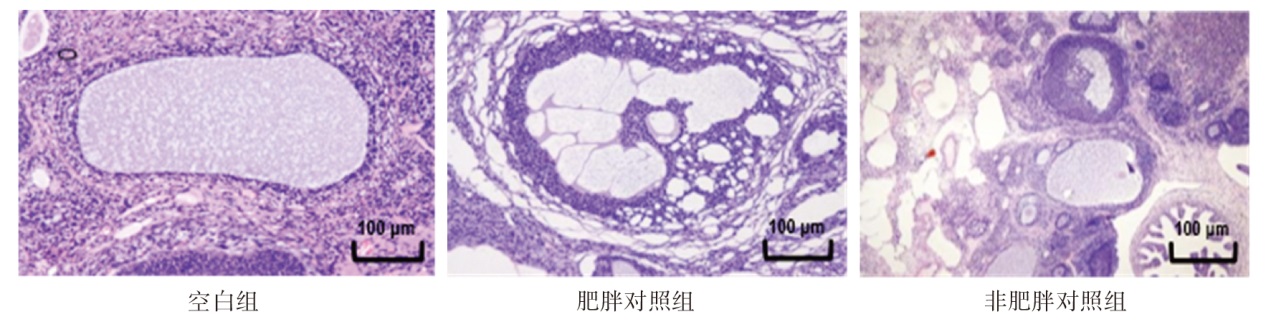
目的:基于核心指标靶式评价苍附导痰汤、知柏地黄汤辨证治疗多囊卵巢综合征(polycystic ovarian syndrome,PCOS)的疗效。方法:采用随机数字表法从54只SD雌性大鼠中随机抽取6只作为空白组(不造模),再随机各抽取24只大鼠分别构建肥胖型PCOS大鼠和非肥胖型PCOS大鼠模型,均分为对照组(肥胖对照组/非肥胖对照组)、达英-35组、苍附导痰汤组和知柏地黄汤组,每组6只。观察大鼠形态、体质量、动情周期、卵巢形态及血清性激素和糖脂代谢水平。结果:造模后除空白组外,肥胖对照组和非肥胖对照组大鼠均没有规律的动情周期。肥胖型PCOS大鼠表现为脾虚痰湿证的证候特点,非肥胖型PCOS大鼠呈现肾阴虚证的证候特点。造模后肥胖对照组、非肥胖对照组大鼠血清睾酮(testosterone,T)、黄体生成素(luteinizing hormone,LH)、空腹血糖(fasting blood glucose,FBG)、空腹胰岛素(fasting insulin,FINS)、总胆固醇(total cholesterol,TC)、甘油三酯(triglyceride,TG)和低密度脂蛋白胆固醇(low-density lipoprotein cholesterol,LDL-C)均高于空白组,且非肥胖对照组LH高于肥胖对照组大鼠,而肥胖对照组TC、TG、LDL-C高于非肥胖对照组大鼠(均P<0.05)。给药后达英-35组、苍附导痰汤组大鼠血清T、LH低于肥胖对照组,苍附导痰汤组大鼠FINS、TC、TG、LDL-C、卵巢体积和质量均低于肥胖对照组(均P<0.05)。非肥胖型PCOS大鼠给药后达英-35组、知柏地黄汤组大鼠血清T、LH低于非肥胖对照组,知柏地黄汤组大鼠FINS、TG、LDL-C、卵巢体积和质量均低于非肥胖对照组(均P<0.05)。结论:从实验层面证实了肥胖可以作为PCOS辨证分型的典型特征,肥胖型PCOS用苍附导痰汤治疗、非肥胖型PCOS用知柏地黄汤治疗效果显著,彰显了中医“同病异治”辨证论治思想的智慧,也为中医辨证论治、分型治疗PCOS提供了动物实验数据支持。

关键词: 多囊卵巢综合征, 辨证分型, 脾虚痰湿, 肾阴虚, 肥胖症, 动物实验

Abstract:

Objective: To evaluate the efficacy of Cangfu Daotan Decoction and Zhibai Dihuang Decoction in the differential treatment of polycystic ovary syndrome (PCOS), based on the core indicator target evaluation. Methods: Using a random number table method, 6 rats were randomly selected from 54 female SD rats as the blank group (no modeling). The remaining rats were randomly divided into groups for the construction of obese PCOS and non-obese PCOS models, with 24 rats in each category. Each model category was further divided into the control group (obese control group/non-obese control group), the Diane-35 group, the Cangfu Daotan Decoction group and the Zhibai Dihuang Decoction group, with 6 rats in each group. The rat morphology, body mass, estrous cycle, ovarian morphology, serum sex hormones, and glucose and lipid metabolism levels were compared. Results: After modeling, except for the blank group, the rats in both the obese and non-obese control groups lacked a regular estrous cycle. The obese PCOS rats exhibited characteristics of spleen deficiency and phlegm-dampness syndrome, while the non-obese PCOS rats showed characteristics of kidney yin deficiency syndrome. After modeling, serum testosterone (T), luteinizing hormone (LH), fasting blood glucose (FBG), fasting insulin (FINS), total cholesterol (TC), triglyceride (TG), and low-density lipoprotein cholesterol (LDL-C) in the obese and non-obese control groups were significantly higher than those in the blank group. LH in the non-obese control group was significantly higher than in the obese control group, while TC, TG, and LDL-C in the obese control group were significantly higher than in the non-obese control group (all P<0.05). After administration, serum T and LH in the Diane-35 group and Cangfu Daotan Decoction group were significantly lower than in the obese control group, and FINS, TC, TG, LDL-C, ovarian volume, and mass in the Cangfu Daotan Decoction group were lower than in the obese control group (all P<0.05). In non-obese PCOS rats, after administration, serum T and LH in the Diane-35 group and Zhibai Dihuang Decoction group were significantly lower than those in the non-obese control group, and FINS, TG, LDL-C, ovarian volume, and mass in the Zhibai Dihuang Decoction group were lower than those in the non-obese control group (all P<0.05). Conclusions: This study experimentally confirms that obesity can serve as a typical characteristic for the differential diagnosis of PCOS. The treatment of obese PCOS with Cangfu Daotan Decoction and non-obese PCOS with Zhibai Dihuang Decoction yields significant effects. This highlights the wisdom of the traditional Chinese medicine principle of "treating the same disease with different methods" and provides animal experimental data supporting the syndrome differentiation and classification treatment of PCOS in traditional Chinese medicine.

Key words: Polycystic ovary syndrome, Syndrome differentiation classification, Phlegm dampness due to spleen deficiency, Syndrome of deficiency of kidney yin, Obesity, Animal experimentation