
国际生殖健康/计划生育杂志 ›› 2026, Vol. 45 ›› Issue (4): 306-310.doi: 10.12280/gjszjk.20260238
刘金玉, 马瑞红, 赵志梅( )
)
收稿日期:2026-05-07
出版日期:2026-07-15
发布日期:2026-07-27
通讯作者:
赵志梅
E-mail:zhaozhim2003@aliyun.com
基金资助:
LIU Jin-yu, MA Rui-hong, ZHAO Zhi-mei()
Received:2026-05-07
Published:2026-07-15
Online:2026-07-27
Contact:
ZHAO Zhi-mei
E-mail:zhaozhim2003@aliyun.com
摘要:
心理应激通过多系统网络干扰生殖功能,已成为生殖医学研究热点。常用慢性心理应激造模方法包括慢性束缚应激、慢性不可预知性温和应激、社交挫败应激、社交隔离应激及早期生命应激等。心理应激通过激活下丘脑-垂体-肾上腺轴,抑制下丘脑-垂体-性腺轴功能,导致性激素分泌异常;同时诱发生殖组织氧化损伤与慢性炎症反应;肠道菌群失衡通过肠-脑-性腺轴进一步放大应激效应;表观遗传修饰则介导应激效应的长期化与代际传递。未来应整合多组学技术,构建标准化慢性应激模型,探索应激相关生殖障碍的早期干预靶点与个体化策略,为临床防治提供理论支撑。
刘金玉, 马瑞红, 赵志梅. 心理应激致生殖功能障碍的动物模型及机制研究进展[J]. 国际生殖健康/计划生育杂志, 2026, 45(4): 306-310.
LIU Jin-yu, MA Rui-hong, ZHAO Zhi-mei. Research Progress on the Animal Models and Mechanisms of Psychological Stress-Induced Reproductive Dysfunction[J]. Journal of International Reproductive Health/Family Planning, 2026, 45(4): 306-310.
| 名称 | 造模原理 | 核心行为学改变 |
|---|---|---|
| 慢性束缚应激 | 躯体+心理限制 | 焦虑样行为、探索性下降 |
| 慢性不可预知性温和应激 | 不可预测性刺激 | 快感缺失、绝望行为 |
| 社交挫败应激 | 社会对抗失败 | 社交回避、焦虑、抑郁 |
| 社交隔离应激 | 长期社会剥夺 | 认知缺陷、焦虑、攻击性 |
| 早期生命应激 | 早期亲子依恋中断 | 成年后应激敏感性升高、HPA轴编程改变 |
表1 常用慢性心理应激动物模型的比较
| 名称 | 造模原理 | 核心行为学改变 |
|---|---|---|
| 慢性束缚应激 | 躯体+心理限制 | 焦虑样行为、探索性下降 |
| 慢性不可预知性温和应激 | 不可预测性刺激 | 快感缺失、绝望行为 |
| 社交挫败应激 | 社会对抗失败 | 社交回避、焦虑、抑郁 |
| 社交隔离应激 | 长期社会剥夺 | 认知缺陷、焦虑、攻击性 |
| 早期生命应激 | 早期亲子依恋中断 | 成年后应激敏感性升高、HPA轴编程改变 |
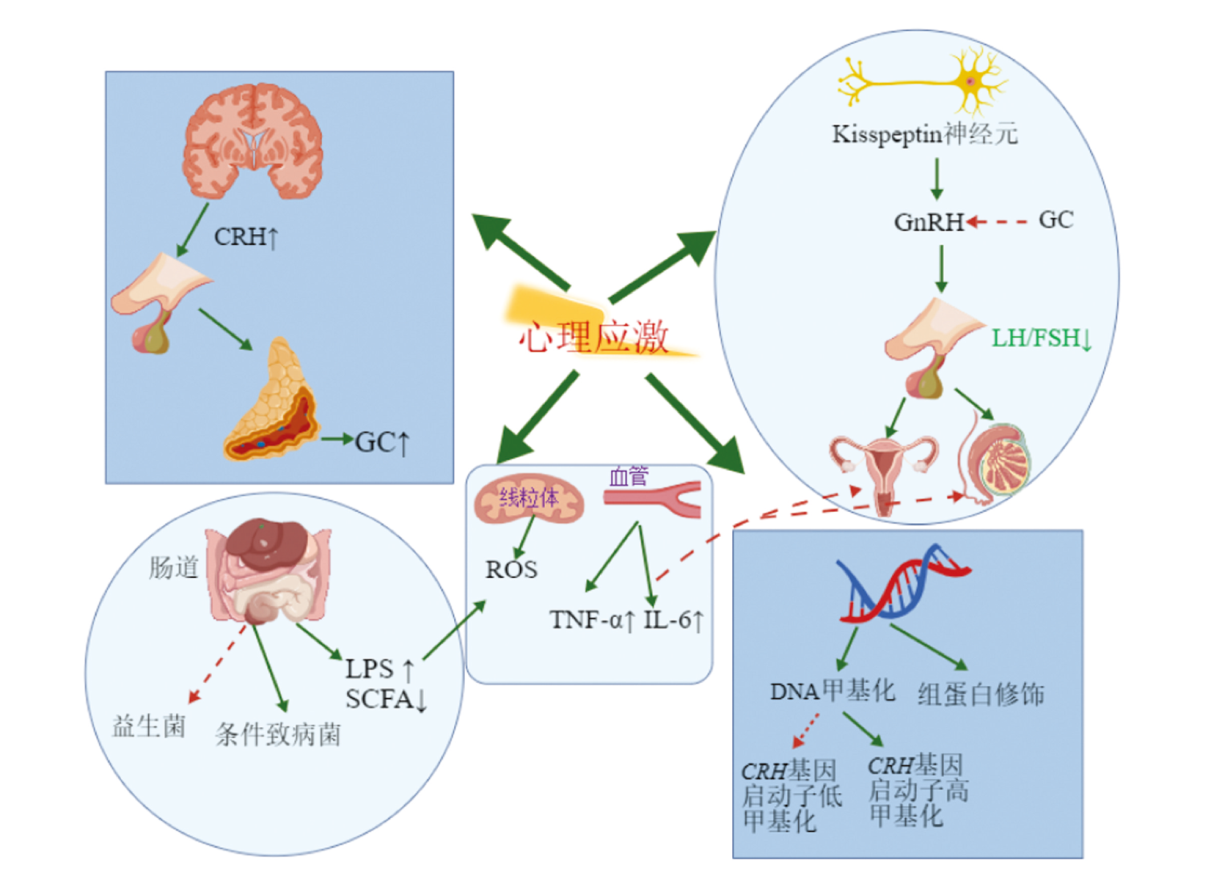
图1 心理应激致生殖功能障碍的多机制交互网络示意图 注:GC 糖皮质激素,LPS 脂多糖,SCFA 短链脂肪酸。
| [1] |
Sapolsky RM. Stress and the brain: individual variability and the inverted-U[J]. Nat Neurosci, 2015, 18(10):1344-1346. doi: 10.1038/nn.4109.
pmid: 26404708 |
| [2] |
McEwen BS. Physiology and neurobiology of stress and adaptation: central role of the brain[J]. Physiol Rev, 2007, 87(3):873-904. doi: 10.1152/physrev.00041.2006.
pmid: 17615391 |
| [3] | Kaltsas A. Oxidative Stress and Male Infertility: The Protective Role of Antioxidants[J]. Medicina(Kaunas), 2023, 59(10):1769. doi: 10.3390/medicina59101769. |
| [4] | Han Y, Lin X. The relationship between psychological stress and ovulatory disorders and its molecular mechanisms: a narrative review[J]. J Psychosom Obstet Gynaecol, 2024, 45(1):2418110. doi: 10.1080/0167482X.2024.2418110. |
| [5] | Selye H. A syndrome produced by diverse nocuous agents. 1936[J]. J Neuropsychiatry Clin Neurosci, 1998, 10(2):230-231. doi: 10.1176/jnp.10.2.230a. |
| [6] |
Paré WP. Passive-avoidance behavior in Wistar-Kyoto (WKY), Wistar, and Fischer-344 rats[J]. Physiol Behav, 1993, 54(5):845-852. doi: 10.1016/0031-9384(93)90291-m.
pmid: 8248372 |
| [7] | Chiba S, Numakawa T, Ninomiya M, et al. Chronic restraint stress causes anxiety- and depression-like behaviors, downregulates glucocorticoid receptor expression, and attenuates glutamate release induced by brain-derived neurotrophic factor in the prefrontal cortex[J]. Prog Neuropsychopharmacol Biol Psychiatry, 2012, 39(1):112-119. doi: 10.1016/j.pnpbp.2012.05.018. |
| [8] |
Singh S, Tripathy S, Rawat A, et al. Pre-clinical Investigations of Therapeutic Markers Associated with Acute and Chronic Restraint Stress: A Nuclear Magnetic Resonance Based Contrast Metabolic Approach[J]. Nanotheranostics, 2023, 7(1):91-101. doi: 10.7150/ntno.76294.
pmid: 36593795 |
| [9] |
Katz RJ, Roth KA, Carroll BJ. Acute and chronic stress effects on open field activity in the rat: implications for a model of depression[J]. Neurosci Biobehav Rev, 1981, 5(2):247-251. doi: 10.1016/0149-7634(81)90005-1.
pmid: 7196554 |
| [10] | Willner P. Validity, reliability and utility of the chronic mild stress model of depression: a 10-year review and evaluation[J]. Psychopharmacology(Berl), 1997, 134(4):319-329. doi: 10.1007/ s002130050456. |
| [11] |
Golden SA, Covington HE, Berton O, et al. A standardized protocol for repeated social defeat stress in mice[J]. Nat Protoc, 2011, 6(8):1183-1191. doi: 10.1038/nprot.2011.361.
pmid: 21799487 |
| [12] |
Berton O, McClung CA, Dileone RJ, et al. Essential role of BDNF in the mesolimbic dopamine pathway in social defeat stress[J]. Science, 2006, 311(5762):864-868. doi: 10.1126/science. 1120972.
pmid: 16469931 |
| [13] | Kudryavtseva NN. A sensory contact model for the study of aggressive and submissive behavior in male mice[J]. Aggressive Behav, 1991, 17(5):285-291. doi: 10.1002/1098-2337(1991)17:5<285::AID-AB2480170505>3.0.CO;2-P. |
| [14] | Harlow HF, Suomi SJ. Social recovery by isolation-reared monkeys[J]. Proc Natl Acad Sci U S A, 1971, 68(7):1534-1538. doi: 10.1073/pnas.68.7.1534. |
| [15] |
Fone KC, Porkess MV. Behavioural and neurochemical effects of post-weaning social isolation in rodents-relevance to developmental neuropsychiatric disorders[J]. Neurosci Biobehav Rev, 2008, 32(6):1087-1102. doi: 10.1016/j.neubiorev.2008. 03.003.
pmid: 18423591 |
| [16] | Plotsky PM, Meaney MJ. Early, postnatal experience alters hypothalamic corticotropin-releasing factor (CRF) mRNA, median eminence CRF content and stress-induced release in adult rats[J]. Brain Res Mol Brain Res, 1993, 18(3):195-200. doi: 10.1016/0169-328x(93)90189-v. |
| [17] | Handa RJ, Weiser MJ. Gonadal steroid hormones and the hypothalamo-pituitary-adrenal axis[J]. Front Neuroendocrinol, 2014, 35(2):197-220. doi: 10.1016/j.yfrne.2013.11.001. |
| [18] |
Herman JP, McKlveen JM, Ghosal S, et al. Regulation of the Hypothalamic-Pituitary-Adrenocortical Stress Response[J]. Compr Physiol, 2016, 6(2):603-621. doi: 10.1002/cphy.c150015.
pmid: 27065163 |
| [19] |
Chandran UR, Attardi B, Friedman R, et al. Glucocorticoid receptor-mediated repression of gonadotropin-releasing hormone promoter activity in GT1 hypothalamic cell lines[J]. Endocrinology, 1994, 134(3):1467-1474. doi: 10.1210/endo.134.3.8119188.
pmid: 8119188 |
| [20] | Pereira SA, Fontes AN, Arvizu-sanchez L, et al. OR23-02 GABAergic and Kisspeptin Neurons Mediate Effects of Stress-induced Glucocorticoids on Reproduction in an Opposite Manner in Female Mice[J]. J Endocr Soc, 2024, 8(Suppl 1):bvae163.2426. doi: 10.1210/jendso/bvae163.2426. |
| [21] | Medina H, Flores A, Juárez-Rojas L, et al. Chronic stress disturbs neuroendocrine control of reproduction and fertility in male rats[J]. Reprod Biol, 2025, 25(3):101027. doi: 10.1016/j.repbio. 2025.101027. |
| [22] | Silva V, Soares S, Miguelote R. Psychological stress and functional ovarian suppression in women with PCOM: an observational study of FHA-like neuroendocrine phenotypes[J]. Arch Womens Ment Health, 2026, 29(1):10. doi: 10.1007/s00737-025-01657-z. |
| [23] | Mohamed ZI, Sivalingam M, Radhakrishnan AK, et al. Chronic unpredictable stress (CUS) reduced phoenixin expression, induced abnormal sperm and testis morphology in male rats[J]. Neuropeptides, 2024, 107:102447. doi: 10.1016/j.npep.2024. 102447. |
| [24] | 程蕊, 刘妍, 杨慧, 等. 不同程度心理应激对小鼠卵巢内氧化应激水平的影响[J]. 国际生殖健康/计划生育杂志, 2020, 39(2):93-96. doi: 10.3969/j.issn.1674-1889.2020.02.001. |
| [25] | Sharma P, Kaushal N, Saleth LR, et al. Oxidative stress-induced apoptosis and autophagy: Balancing the contrary forces in spermatogenesis[J]. Biochim Biophys Acta Mol Basis Dis, 2023, 1869(6): 166742. doi: 10.1016/j.bbadis.2023.166742. |
| [26] | Mo L, Wu H, Zhang M, et al. The mechanism of oxidative stress in asthenozoospermia and antioxidant strategies: a review[J]. Front Endocrinol(Lausanne), 2025, 16:1670762. doi: 10.3389/fendo. 2025.1670762. |
| [27] | 阿孜古丽·阿力木江, 买买提·依斯热依力, 王婧, 等. 心理应激对雌性小鼠胃黏膜炎症和卵巢功能早衰的影响[J]. 中华胃食管反流病电子杂志, 2023, 10(2):69-76. doi: 10.3877/cma.j.issn.2095-8765.2023.02.003. |
| [28] | van der Burg B, Liden J, Okret S, et al. Nuclear factor-κB repression in antiinflammation and immunosuppression by glucocorticoids[J]. Trends Endocrinol Metab, 1997, 8(4):152-157. doi: 10.1016/s1043-2760(97)00006-4. |
| [29] | Zhang J, Kong DL, Xiao B, et al. Restraint stress of male mice triggers apoptosis in spermatozoa and spermatogenic cells via activating the TNF-α system[J]. Zygote, 2020:28(2):145-154. doi: 10.1017/S0967199419000844. |
| [30] | Zhao XL, Rong BL, Dou Z, et al. Kai Yu Zhong Yu recipe mitigates stress-induced accelerated follicle loss in mice by regulating the interplay between apoptosis and autophagy via the SIRT1/FOXO1/3 pathway[J]. Phytomedicine Plus, 2024, 4(4):100623. doi: 10.1016/j.phyplu.2024.100623. |
| [31] | Zheng JC, Jin ZR, Liu BH, et al. Chronic stress drives oligoasthenozoospermia via gut microbiota-vitamin-Sting1/Slc9c2 axis[J]. Nat Commun, 2026, 17(1):4108. doi: 10.1038/s41467-026-72450-4. |
| [32] | Fu L, Wang M, Li D, et al. Microbial metabolites short chain fatty acids, tight junction, gap junction, and reproduction: a review[J]. Front Cell Dev Biol, 2025, 13:1624415. doi: 10.3389/fcell. 2025.1624415. |
| [33] | Khazaei M, Bahar A, Porbaran M, et al. Diet and gut microbiota during depression and stress[J]. Discover Food, 2026, 6:111. doi: 10.1007/s44187-026-00846-8. |
| [34] |
Akhatova A, Jones C, Coward K, et al. How do lifestyle and environmental factors influence the sperm epigenome? Effects on sperm fertilising ability, embryo development, and offspring health[J]. Clin Epigenetics, 2025, 17(1):7. doi: 10.1186/s13148-025-01815-1.
pmid: 39819375 |
| [35] | Khor YM, Soga T, Parhar IS. Early-life stress changes expression of GnRH and kisspeptin genes and DNA methylation of GnRH3 promoter in the adult zebrafish brain[J]. Gen Comp Endocrinol, 2016, 227:84-93. doi: 10.1016/j.ygcen.2015.12.004. |
| [36] | Ohno H, Yamamuro Y, Aizawa S. Chronic social defeat stress alters DNA methylation profiles of male germ cells in mice[J]. Biochem Biophys Res Commun, 2025, 758:151650. doi: 10.1016/j.bbrc.2025.151650. |
| [37] |
Xu J, Wang R, Liu Y, et al. Short- and long-term alterations of FKBP5-GR and specific microRNAs in the prefrontal cortex and hippocampus of male rats induced by adolescent stress contribute to depression susceptibility[J]. Psychoneuroendocrinology, 2019, 101:204-215. doi: 10.1016/j.psyneuen.2018.11.008.
pmid: 30469088 |
| [1] | 冯宇, 张宁, 席瑾, 袁榕澧, 刘奇, 赵娴, 王梦静. 人工智能在辅助生殖技术领域的应用[J]. 国际生殖健康/计划生育杂志, 2026, 45(5): 353-357. |
| [2] | 杨亚男, 黄云佳, 徐于睿. 辅助生殖治疗患者对人工智能应用的了解及使用意愿[J]. 国际生殖健康/计划生育杂志, 2026, 45(5): 358-361. |
| [3] | 李欣欣, 黄雨姗, 干恬, 孟悦. GnRH拮抗剂方案新鲜胚胎移植妊娠结局的列线图预测模型构建[J]. 国际生殖健康/计划生育杂志, 2026, 45(5): 368-372. |
| [4] | 苗力丹, 任菲, 刘晴, 刘硕, 李晓晓. 知信行模式下烟台某职业学院学生性与生殖健康现状调查与对策建议[J]. 国际生殖健康/计划生育杂志, 2026, 45(5): 373-379. |
| [5] | 余照娟, 郭培培. 序贯移植在反复着床失败中的临床价值再评估[J]. 国际生殖健康/计划生育杂志, 2026, 45(5): 401-406. |
| [6] | 何方宇, 张润瑶, 高明霞. 生殖器结核对接受体外受精-胚胎移植女性生育力的影响及预防管理[J]. 国际生殖健康/计划生育杂志, 2026, 45(5): 407-411. |
| [7] | 李晓莲, 张梦宇, 陶慧敏, 樊雨邗, 李梅, 尹耀学, 侯振. 深部浸润型子宫内膜异位症合并不孕症的治疗路径选择:手术还是IVF?[J]. 国际生殖健康/计划生育杂志, 2026, 45(5): 412-417. |
| [8] | 阳姣, 杨凱丽, 高婷, 韩雪, 王玲. 高压氧治疗对高海拔低氧环境下女性生殖功能损伤的保护作用[J]. 国际生殖健康/计划生育杂志, 2026, 45(5): 418-424. |
| [9] | 刘闯, 孟鹏, 王红娜, 魏艳玲, 王晶, 相里倩倩, 张建芳. 生殖医学中心临床胚胎师的职业发展及标准化培养[J]. 国际生殖健康/计划生育杂志, 2026, 45(4): 265-269. |
| [10] | 陈海霞, 杨琳, 穆晓环, 宋学茹, 田文艳, 白晓红. SUN5复合杂合突变导致无头精子症一例[J]. 国际生殖健康/计划生育杂志, 2026, 45(4): 285-289. |
| [11] | 陈梦婷, 刘钧彦, 包洪初. 宫内合并宫角妊娠行选择性减胎术一例[J]. 国际生殖健康/计划生育杂志, 2026, 45(4): 297-301. |
| [12] | 陈天泽, 王丹丹, 洪菊生, 杨光平. 生长激素/胰岛素样生长因子-1轴调控男性生殖功能的研究进展[J]. 国际生殖健康/计划生育杂志, 2026, 45(4): 301-305. |
| [13] | 李雪, 赵菁华, 崔娜, 王书华, 陈丽, 田文艳. 不同减重方式对生殖健康的影响[J]. 国际生殖健康/计划生育杂志, 2026, 45(4): 318-325. |
| [14] | 林银翠, 滕伟, 陈燕, 王善林. 非标准产科抗磷脂综合征患者心理弹性通过应对方式影响妊娠压力的中介效应研究[J]. 国际生殖健康/计划生育杂志, 2026, 45(3): 196-203. |
| [15] | 陈文俊, 徐献丽, 张艺超. 褪黑素保护卵巢储备功能的机制及应用现状[J]. 国际生殖健康/计划生育杂志, 2026, 45(3): 224-229. |
| 阅读次数 | ||||||
|
全文 |
|
|||||
|
摘要 |
|
|||||
