
Journal of International Reproductive Health/Family Planning ›› 2025, Vol. 44 ›› Issue (5): 353-360.doi: 10.12280/gjszjk.20250141
• Original Article • Next Articles
LI Meng-yuan, GAO Zheng, XU Xin( )
)
Received:2025-03-24
Published:2025-09-15
Online:2025-09-12
Contact:
XU Xin
E-mail:xuxin10104@163.com
LI Meng-yuan, GAO Zheng, XU Xin. Mechanism of Yishen Quzhuo Formula in Treating PCOS-IR Based on Network Pharmacology and Animal Experiments[J]. Journal of International Reproductive Health/Family Planning, 2025, 44(5): 353-360.
Add to citation manager EndNote|Ris|BibTeX
| 基因 | 引物 | 序列(5′→3′) |
|---|---|---|
| GAPDH | 正向 | TCATTGACCTCAACTACATGG |
| 反向 | TCGCTCCTGGAAGATGGTG | |
| STAT3 | 正向 | TTAACATTCTGGGCACGAACA |
| 反向 | TGACAATCAAGGAGGCATCAC | |
| AKT1 | 正向 | CGACGTAGCCATTGTGAAGGAG |
| 反向 | ATTGTGCCACTGAGAAGTTGTTG | |
| TP53 | 正向 | ATGGAGGATTCACAGTCGGATAT |
| 反向 | CGCTGTGGTGGGCAGAATAT | |
| EGFR | 正向 | CTCAGCAGGCCACACTTGTA |
| 反向 | TGCATGGTTACTCCAGCTTAGA | |
| HSP90 | 正向 | ACATGCTGCGGAGGGTTAAG |
| 反向 | CTGCTCGGAGTCATCTGTGGT |
| 基因 | 引物 | 序列(5′→3′) |
|---|---|---|
| GAPDH | 正向 | TCATTGACCTCAACTACATGG |
| 反向 | TCGCTCCTGGAAGATGGTG | |
| STAT3 | 正向 | TTAACATTCTGGGCACGAACA |
| 反向 | TGACAATCAAGGAGGCATCAC | |
| AKT1 | 正向 | CGACGTAGCCATTGTGAAGGAG |
| 反向 | ATTGTGCCACTGAGAAGTTGTTG | |
| TP53 | 正向 | ATGGAGGATTCACAGTCGGATAT |
| 反向 | CGCTGTGGTGGGCAGAATAT | |
| EGFR | 正向 | CTCAGCAGGCCACACTTGTA |
| 反向 | TGCATGGTTACTCCAGCTTAGA | |
| HSP90 | 正向 | ACATGCTGCGGAGGGTTAAG |
| 反向 | CTGCTCGGAGTCATCTGTGGT |
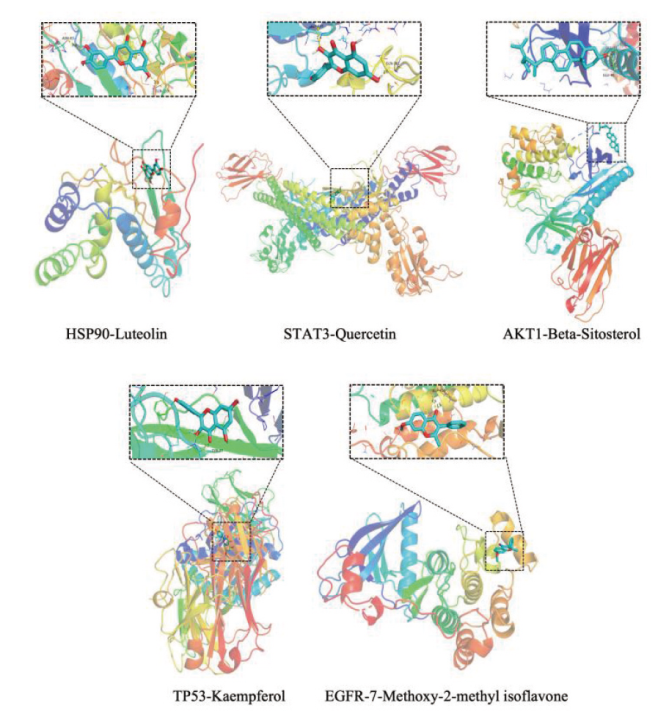
| 编号 | 核心靶点 | PDB ID | 化合物 | 结合能 (kcal/mol) |
|---|---|---|---|---|
| 1 | AKT1 | 8uw9 | β-谷甾醇 | -7.6 |
| 2 | TP53 | 6vrn | 山柰酚 | -7.8 |
| 3 | STAT3 | 6TLC | 槲皮素 | -8.6 |
| 4 | EGFR | 7zyn | 7-甲氧基-2-甲基异黄酮 | -6.4 |
| 5 | HSP90 | 7s8y | 木犀草素 | -8.6 |
| 编号 | 核心靶点 | PDB ID | 化合物 | 结合能 (kcal/mol) |
|---|---|---|---|---|
| 1 | AKT1 | 8uw9 | β-谷甾醇 | -7.6 |
| 2 | TP53 | 6vrn | 山柰酚 | -7.8 |
| 3 | STAT3 | 6TLC | 槲皮素 | -8.6 |
| 4 | EGFR | 7zyn | 7-甲氧基-2-甲基异黄酮 | -6.4 |
| 5 | HSP90 | 7s8y | 木犀草素 | -8.6 |
| 组别 | n | FSH (mIU/mL) | LH (mIU/mL) | LH/FSH 比值 | 睾酮 (ng/mL) |
|---|---|---|---|---|---|
| 空白组 | 8 | 1.766±0.317 | 7.438±0.374* | 4.376±1.062* | 0.643±0.032* |
| 模型组 | 8 | 1.901±0.281 | 11.700±1.036 | 6.305±1.305 | 0.888±0.086 |
| 益肾祛 浊方组 | 8 | 1.668±0.230 | 9.254±0.465* | 5.656±0.918 | 0.763±0.086* |
| 二甲双 胍组 | 8 | 1.723±0.139 | 9.343±0.563* | 5.456±0.582 | 0.758±0.068* |
| F | 1.264 | 55.910 | 5.122 | 15.690 | |
| P | 0.306 | <0.001 | 0.006 | <0.001 |
| 组别 | n | FSH (mIU/mL) | LH (mIU/mL) | LH/FSH 比值 | 睾酮 (ng/mL) |
|---|---|---|---|---|---|
| 空白组 | 8 | 1.766±0.317 | 7.438±0.374* | 4.376±1.062* | 0.643±0.032* |
| 模型组 | 8 | 1.901±0.281 | 11.700±1.036 | 6.305±1.305 | 0.888±0.086 |
| 益肾祛 浊方组 | 8 | 1.668±0.230 | 9.254±0.465* | 5.656±0.918 | 0.763±0.086* |
| 二甲双 胍组 | 8 | 1.723±0.139 | 9.343±0.563* | 5.456±0.582 | 0.758±0.068* |
| F | 1.264 | 55.910 | 5.122 | 15.690 | |
| P | 0.306 | <0.001 | 0.006 | <0.001 |
| 组别 | n | FPG(mmol/L) | FINS(mIU/mL) | HOMA-IR |
|---|---|---|---|---|
| 空白组 | 8 | 5.225±0.512 | 18.600±0.557* | 4.311±0.377* |
| 模型组 | 8 | 5.688±0.669 | 51.600±1.858 | 13.060±1.722 |
| 益肾祛 浊方组 | 8 | 5.700±0.338 | 41.400±0.951* | 10.480±0.574* |
| 二甲双 胍组 | 8 | 5.588±0.368 | 40.540±1.131* | 10.070±0.694* |
| F | 1.651 | 1 039.000 | 111.200 | |
| P | 0.200 | <0.001 | <0.001 |
| 组别 | n | FPG(mmol/L) | FINS(mIU/mL) | HOMA-IR |
|---|---|---|---|---|
| 空白组 | 8 | 5.225±0.512 | 18.600±0.557* | 4.311±0.377* |
| 模型组 | 8 | 5.688±0.669 | 51.600±1.858 | 13.060±1.722 |
| 益肾祛 浊方组 | 8 | 5.700±0.338 | 41.400±0.951* | 10.480±0.574* |
| 二甲双 胍组 | 8 | 5.588±0.368 | 40.540±1.131* | 10.070±0.694* |
| F | 1.651 | 1 039.000 | 111.200 | |
| P | 0.200 | <0.001 | <0.001 |
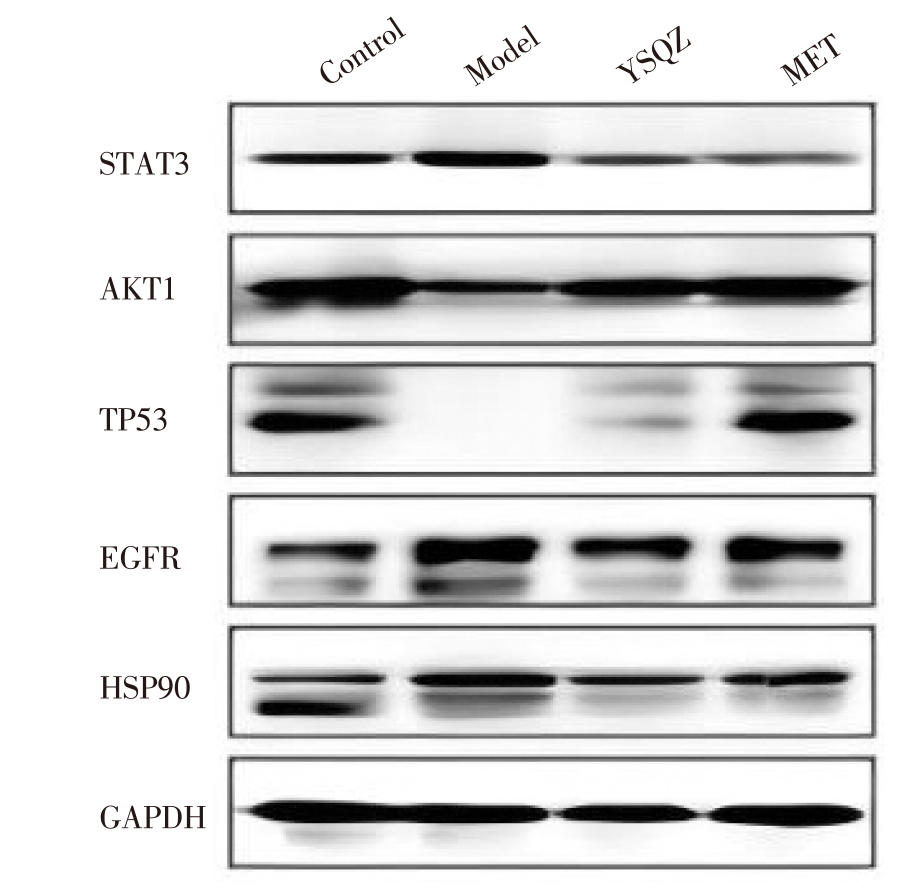
| 组别 | n | STAT3 | AKT1 | TP53 | EGFR | HSP90 |
|---|---|---|---|---|---|---|
| 空白组 | 8 | 0.505±0.065* | 0.524±0.046* | 0.655±0.032* | 0.550±0.056* | 0.708±0.017* |
| 模型组 | 8 | 0.716±0.040 | 0.320±0.028 | 0.350±0.045 | 0.790±0.065 | 1.043±0.070 |
| 益肾祛浊方组 | 8 | 0.450±0.053* | 0.374±0.017* | 0.491±0.024* | 0.559±0.026* | 0.765±0.042* |
| 二甲双胍组 | 8 | 0.515±0.083* | 0.450±0.028* | 0.464±0.042* | 0.606±0.045* | 0.833±0.015* |
| F | 28.080 | 64.510 | 93.670 | 40.280 | 96.560 | |
| P | <0.001 | <0.001 | <0.001 | <0.001 | <0.001 |
| 组别 | n | STAT3 | AKT1 | TP53 | EGFR | HSP90 |
|---|---|---|---|---|---|---|
| 空白组 | 8 | 0.505±0.065* | 0.524±0.046* | 0.655±0.032* | 0.550±0.056* | 0.708±0.017* |
| 模型组 | 8 | 0.716±0.040 | 0.320±0.028 | 0.350±0.045 | 0.790±0.065 | 1.043±0.070 |
| 益肾祛浊方组 | 8 | 0.450±0.053* | 0.374±0.017* | 0.491±0.024* | 0.559±0.026* | 0.765±0.042* |
| 二甲双胍组 | 8 | 0.515±0.083* | 0.450±0.028* | 0.464±0.042* | 0.606±0.045* | 0.833±0.015* |
| F | 28.080 | 64.510 | 93.670 | 40.280 | 96.560 | |
| P | <0.001 | <0.001 | <0.001 | <0.001 | <0.001 |
| 组别 | n | STAT3 | AKT1 | TP53 | EGFR | HSP90 |
|---|---|---|---|---|---|---|
| 空白组 | 8 | 6.941±0.608* | 5.586±1.269* | 3.524±0.219* | 7.839±0.783* | 1.853±0.214* |
| 模型组 | 8 | 9.085±0.876 | 3.218±0.469 | 2.414±0.226 | 10.520±0.277 | 3.459±0.263 |
| 益肾祛浊方组 | 8 | 7.259±0.414* | 3.881±0.644* | 3.201±0.336 | 8.860±0.833* | 2.625±0.275* |
| 二甲双胍组 | 8 | 7.216±0.879* | 4.261±0.608* | 2.910±0.183 | 9.270±0.267* | 2.655±0.151* |
| F | 14.870 | 12.180 | 28.950 | 27.070 | 64.530 | |
| P | <0.001 | <0.001 | <0.001 | <0.001 | <0.001 |
| 组别 | n | STAT3 | AKT1 | TP53 | EGFR | HSP90 |
|---|---|---|---|---|---|---|
| 空白组 | 8 | 6.941±0.608* | 5.586±1.269* | 3.524±0.219* | 7.839±0.783* | 1.853±0.214* |
| 模型组 | 8 | 9.085±0.876 | 3.218±0.469 | 2.414±0.226 | 10.520±0.277 | 3.459±0.263 |
| 益肾祛浊方组 | 8 | 7.259±0.414* | 3.881±0.644* | 3.201±0.336 | 8.860±0.833* | 2.625±0.275* |
| 二甲双胍组 | 8 | 7.216±0.879* | 4.261±0.608* | 2.910±0.183 | 9.270±0.267* | 2.655±0.151* |
| F | 14.870 | 12.180 | 28.950 | 27.070 | 64.530 | |
| P | <0.001 | <0.001 | <0.001 | <0.001 | <0.001 |
| [1] | 中国中西医结合学会妇产科专业委员会, 张明敏. 多囊卵巢综合征中西医结合诊治指南[J]. 中国中西医结合杂志, 2024, 44(1):5-18. doi: 10.7661/j.cjim.20230726.278. |
| [2] | 首都医科大学附属北京中医医院.一种益肾祛浊中药组合物和应用:中国, CN201710368825.2[P]. 2020-12-01. |
| [3] | Aggarwal S, Rosenblum C, Gould M, et al. Expanding and Enriching the LncRNA Gene-Disease Landscape Using the GeneCaRNA Database[J]. Biomedicines, 2024, 12(6):1305. doi: 10.3390/biomedicines12061305. |
| [4] | Amberger JS, Bocchini CA, Scott AF, et al. OMIM.org: leveraging knowledge across phenotype-gene relationships[J]. Nucleic Acids Res, 2019, 47(D1):D1038-D1043. doi: 10.1093/nar/gky1151. |
| [5] | Knox C, Wilson M, Klinger CM, et al. DrugBank 6.0: the DrugBank Knowledgebase for 2024[J]. Nucleic Acids Res, 2024, 52(D1):D1265-D1275. doi: 10.1093/nar/gkad976. |
| [6] | Zhou Y, Zhang Y, Zhao D, et al. TTD: Therapeutic Target Database describing target druggability information[J]. Nucleic Acids Res, 2024, 52(D1):D1465-D1477. doi: 10.1093/nar/gkad751. |
| [7] | Szklarczyk D, Kirsch R, Koutrouli M, et al. The STRING database in 2023: protein-protein association networks and functional enrichment analyses for any sequenced genome of interest[J]. Nucleic Acids Res, 2023, 51(D1):D638-D646. doi: 10.1093/nar/gkac1000. |
| [8] | Sherman BT, Hao M, Qiu J, et al. DAVID: a web server for functional enrichment analysis and functional annotation of gene lists (2021 update)[J]. Nucleic Acids Res, 2022, 50(W1):W216-W221. doi: 10.1093/nar/gkac194. |
| [9] | Bittrich S, Bhikadiya C, Bi C, et al. RCSB Protein Data Bank: Efficient Searching and Simultaneous Access to One Million Computed Structure Models Alongside the PDB Structures Enabled by Architectural Advances[J]. J Mol Biol, 2023, 435(14):167994. doi: 10.1016/j.jmb.2023.167994. |
| [10] | 蔡云, 许昕. 来曲唑联合高脂饲料建立PCOS-IR大鼠模型实验研究[J]. 首都医科大学学报, 2017, 38(2):244-248. doi: 10.3969/j.issn.1006-7795.2017.02.018. |
| [11] | 尹谦, 王明星, 许昕. 益肾祛浊方对多囊卵巢综合征胰岛素抵抗模型大鼠激素受体表达的干预作用[J]. 世界中医药, 2020, 16(6):836-841. doi: 10.3969/j.issn.1673-7202.2020.06.005. |
| [12] | Wang MX, Yin Q, Xu X. A Rat Model of Polycystic Ovary Syndrome with Insulin Resistance Induced by Letrozole Combined with High Fat Diet[J]. Med Sci Monit, 2020,26:e922136. doi: 10.12659/MSM.922136. |
| [13] | Zhou Q, Tang H, Wang Y, et al. Hyperoside mitigates PCOS-associated adipogenesis and insulin resistance by regulating NCOA2-mediated PPAR-γ ubiquitination and degradation[J]. Life Sci, 2025,364:123417. doi: 10.1016/j.lfs.2025.123417. |
| [14] | Su P, Chen C, Pang L, et al. Effects of quercetin on polycystic ovary syndrome in animal models: a systematic review and meta-analysis[J]. Reprod Biol Endocrinol, 2024, 22(1):46. doi: 10.1186/s12958-024-01220-y. |
| [15] | Shoaib M, Saleem A, Zeb A, et al. Chemical Characterization and Ameliorating Effect of Centratherum anthelminticum Extract against Polycystic Ovary Syndrome in Wistar Rats[J]. Int J Endocrinol, 2023,2023:4978562. doi: 10.1155/2023/4978562. |
| [16] | Huang Y, Zhang X. Luteolin alleviates polycystic ovary syndrome in rats by resolving insulin resistance and oxidative stress[J]. Am J Physiol Endocrinol Metab, 2021, 320(6):E1085-E1092. doi: 10.1152/ajpendo.00034.2021. |
| [17] | Soumya V, Deepa S, Thachil KK, et al. GC-MS analysis and in silico docking of constituents of Cinnamomum malabatrum against CYP450 17α and CYP450 19 (Aromatase)- Key targets for hyperandrogenism[J]. Drug Res(Stuttg), 2023, 73(8):441-447.doi: 10.1055/a-2142-5774. |
| [18] | Gao Z, Wang G, Ma X, et al. Troxerutin attenuates insulin resistance via pancreatic IL-22/JAK1/STAT3 signaling activation in dihydrotestosterone-induced polycystic ovary syndrome rats[J]. Am J Physiol Endocrinol Metab, 2022, 323(5):E405-E417. doi: 10.1152/ajpendo.00150.2022. |
| [19] | Li M, Gao S, Kang M, et al. Quercitrin alleviates lipid metabolism disorder in polycystic ovary syndrome-insulin resistance by upregulating PM20D1 in the PI3K/Akt pathway[J]. Phytomedicine, 2023,117:154908. doi: 10.1016/j.phymed.2023.154908. |
| [20] |
Biglari-Zadeh G, Sargazi S, Mohammadi M, et al. Relationship Between Genetic Polymorphisms in Cell Cycle Regulatory Gene TP53 and Polycystic Ovarian Syndrome: A Case-Control Study and In Silico Analyses[J]. Biochem Genet, 2023, 61(5):1827-1849. doi: 10.1007/s10528-023-10349-1.
pmid: 36856940 |
| [21] | An J, Lin T, Guo X, et al. Regulation of the EGFR/PI3K/AKT signaling cascade using the Shengui Yangrong Decoction improves ovulation dysfunction and insulin resistance in polycystic ovary syndrome[J]. Fitoterapia, 2025,182:106407. doi: 10.1016/j.fitote.2025.106407. |
| [22] | Butler AE, Moin A, Sathyapalan T, et al. A Cross-Sectional Study of Alzheimer-Related Proteins in Women with Polycystic Ovary Syndrome[J]. Int J Mol Sci, 2024, 25(2):1158. doi: 10.3390/ijms25021158. |
| [23] | 李梦元, 高征, 梁婧翘, 等. 益肾祛浊方对比二甲双胍治疗多囊卵巢综合征合并胰岛素抵抗的随机对照研究[J]. 中国全科医学, 2024, 27(27):3411-3417,3427. doi: 10.12114/j.issn.1007-9572.2024.0035. |
| [1] | KONG Jing, YU Lan, ZHANG Cui-lian. The Impact of Vitamin D on Assisted Reproductive Technology Outcomes in Women with Polycystic Ovary Syndrome [J]. Journal of International Reproductive Health/Family Planning, 2026, 45(2): 154-159. |
| [2] | WANG Hai-yun, WEI Jia-yu, LAN Tian-ning, ZHANG Ke-xin, ZHANG Hui-ying, TIAN Wen-yan. Research Progress on Amino Acid Metabolism and Polycystic Ovary Syndrome [J]. Journal of International Reproductive Health/Family Planning, 2026, 45(2): 160-165. |
| [3] | LIN Kai-li, LIU Yin, WANG Jiao-jian, SONG Dian-rong, ZHANG Wei, LU Di. Animal Experimental Study on the Efficacy of Traditional Chinese Medicine Syndrome Differentiation Treatment for PCOS Based on Core Indicator Target Evaluation [J]. Journal of International Reproductive Health/Family Planning, 2026, 45(2): 89-96. |
| [4] | LIU Ying, NING Shu-ting, ZHANG Chun-ren, DAI Fang, MO Hui-ying, MA Hong-xia. Effect of Prenatal Intrauterine Exposure to High Anti-Müllerian Hormone and Androgen on the Gut Microbiota of Offspring Mice [J]. Journal of International Reproductive Health/Family Planning, 2026, 45(2): 97-103. |
| [5] | KANG Xu-li, LIU Bo-xin, HE Xiao, ZHAI Hui. Age-Period-Cohort Analysis of the Disease Burden of Polycystic Ovary Syndrome in China from 1990 to 2021 and Prediction of the Trend [J]. Journal of International Reproductive Health/Family Planning, 2026, 45(1): 11-17. |
| [6] | CHEN Wen-xin, YU Chi-yuan, XU Bo-qun. Advances in Clinical and Basic Research on the Transgenerational Inheritance of Polycystic Ovary Syndrome [J]. Journal of International Reproductive Health/Family Planning, 2026, 45(1): 60-66. |
| [7] | LIN Tuo, NING Shu-ting, HUA Ying, YE Li-hua, MA Hong-xia. Research Progress on Anti-Müllerian Hormone and Inhibin B in the Transgenerational Effects of Polycystic Ovary Syndrome [J]. Journal of International Reproductive Health/Family Planning, 2026, 45(1): 66-70. |
| [8] | LENG Ya-wen, SHI Bai-chao, WANG Yu, WU Xiao-ke. The Relationship between Adipokines and Polycystic Ovary Syndrome [J]. Journal of International Reproductive Health/Family Planning, 2025, 44(6): 518-523. |
| [9] | YU Jian-nan, GAO Zhu-wei, GE Hang, LIU Yang, SHI Bai-chao, BAI Yu-xin, GAO Jing-shu, WANG Yu, WU Xiao-ke. The Potential Therapeutic Role of Quercetin in Polycystic Ovary Syndrome [J]. Journal of International Reproductive Health/Family Planning, 2025, 44(5): 393-398. |
| [10] | NIU Jia-jia, WANG Yu, WU Xiao-ke. Research Progress on Probiotic Therapy for Polycystic Ovary Syndrome [J]. Journal of International Reproductive Health/Family Planning, 2025, 44(5): 399-404. |
| [11] | YANG Yi, DENG Lin-wen. Clinical Experience Thought Transmission of Polycystic Ovary Syndrome Based on Spacetime-Medicine Deduction [J]. Journal of International Reproductive Health/Family Planning, 2025, 44(4): 332-337. |
| [12] | LU Feng-juan, CONG Jing, WANG Yu, SHI Bai-chao, GUAN Mu-xin, ZHANG Bei, WU Xiao-ke. The Action of ω-3 Polyunsaturated Fatty Acids in Polycystic Ovary Syndrome [J]. Journal of International Reproductive Health/Family Planning, 2025, 44(3): 215-219. |
| [13] | MA Ying-qi, LI Jia-li, FENG Meng-zhi, SHI Bai-chao, WANG Yu, GAO Jing-shu, WU Xiao-ke. The Mechanism of Chinese Medicine Monomers and Compounds in Treatment of Polycystic Ovary Syndrome, Based on PI3K/Akt Signaling Pathway [J]. Journal of International Reproductive Health/Family Planning, 2025, 44(3): 220-226. |
| [14] | LIU Tong-yao, CHAO Chun-e, TIAN Ning, LI Chen-xue, MA Rui-hong, XIA Tian. The Application of Psychosocial Support in Female Reproductive Disorders [J]. Journal of International Reproductive Health/Family Planning, 2025, 44(3): 232-235. |
| [15] | LI Wen-an, FU Sheng-lan, HOU Zhi-jin, MENG Yu-shi. Research Progress on Tumor Necrosis Factor-α and Its Inhibitors in the Field of Reproduction [J]. Journal of International Reproductive Health/Family Planning, 2025, 44(3): 259-264. |
| Viewed | ||||||
|
Full text |
|
|||||
|
Abstract |
|
|||||
